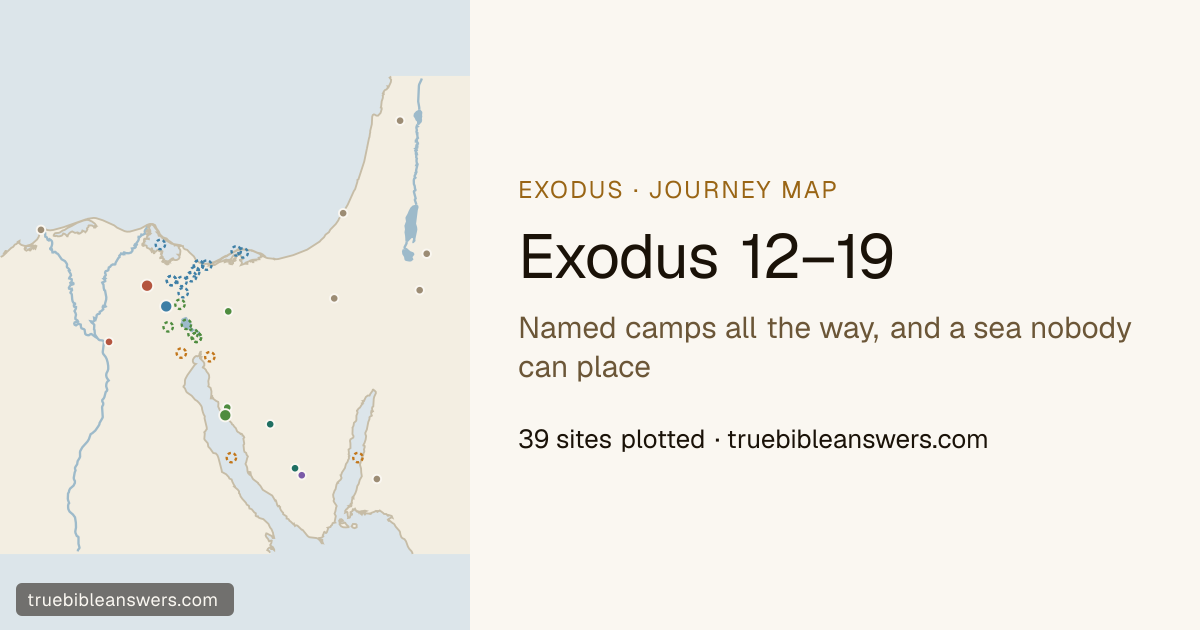
The journey out of Egypt: Named camps all the way, and a sea nobody can place
Read it →Israel leaves Egypt at midnight and comes to Sinai on the third new moon, and almost every stage in between is a named camp — which is what makes the two blanks in the middle of it so conspicuous. The first leg is not in doubt: Rameses to Succoth, a Ramesside capital in the eastern delta to a mound at the western end of the Wadi Tumilat, about forty kilometres east. Nor is the road they did not take. Exodus 13:17 says God did not lead them by way of the land of the Philistines, which was the coast road and the short way, because it ran past garrisons and the people would have turned back; that course is on this map as a course, dashed, going nowhere. After Succoth the ground gives way. Etham is a camp on the edge of the wilderness that five tells claim, and the leading one sits thirteen kilometres west of Succoth, which is the wrong direction. Then comes the camp itself — in front of Pi-hahiroth, between Migdol and the sea, in front of Baal-zephon — which Exodus 14:2 gives as one place with three landmarks and the atlases give as three places up to eighty-two kilometres apart, because each name's leading identification belongs to a different reconstruction of the whole route. The sea is worse: eight candidate waters, from Lake Manzala on the Mediterranean shore to the Gulf of Aqaba three hundred and eighty-six kilometres away, and the front-runner holds 293 of 778 votes. This map pins none of the four. It draws every site the sources offer, in the colour of the reconstruction that offers it — a northern reading on the old Pelusiac frontier, a lakes reading on the isthmus, a southern one at the head of the Gulf of Suez — and sends three approaches out from the last agreed camp, one per reading, each stopping where its own water starts. From Shur the sources close ranks again: Marah, Elim, the wilderness of Sin and Rephidim make one line down the west side of the peninsula, and the mountain at the end of it is Jebel Musa by a clear margin over thirteen rivals — a majority, not a settlement, and the note says which arguments it beat. Three names in the span are ground the map already holds under another name: Massah and Meribah are what Moses called Rephidim after the quarrel, Horeb is the mountain itself. And six places are named and never reached — the Philistine coast, the four peoples who hear about the sea in the Song and are afraid of it, Amalek who came down to Rephidim to fight, the Nile the staff had already struck, and Midian, which Jethro walks in from and goes home to.
Regions on this map
Exodus 12:29–42: the firstborn die at midnight, Pharaoh sends for Moses in the dark, and by morning the people are on the road. Egypt is a whole country here and the dot is the gazetteer's nominal point for it; the march itself starts from one town in the eastern delta.
Named in forty-four verses of this span, more than any other place, and named almost always as somewhere they are being brought out of. The dot is the gazetteer's nominal point for the country; the people themselves are ninety kilometres north-east of it, in the eastern delta around Rameses.
Today: Egypt (nominal point at Ain Shams, Cairo) (representative point)
The town they set out from, and one of the two Exodus 1:11 says they built. Qantir, the Ramesside delta capital, takes 514 votes against 142 for the neighbouring mound at Tell el-Daba — two sites a few kilometres apart rather than two reconstructions, which is why this one can carry a pin.
Today: Qantir, Egypt
Exodus 12:37–13:22: one agreed stage and one road refused. Rameses to Succoth is about forty kilometres east and nobody argues about it; the coast road to Philistia, which was the short way to Canaan, is drawn as the course they were not led along.
The first camp, about forty kilometres east of Rameses at the western end of the Wadi Tumilat, and the last stage of this journey nobody argues about.
Today: Tell el-Maskhuta, Egypt
The camp "on the edge of the wilderness", and the first place in the march where the sources come apart: five tells claim it and the leader holds barely a third of the vote.
Not plotted: the leading candidate, Tell er-Retaba, sits 13 km west of Succoth's — the wrong direction for the next camp out — and the four behind it spread fifty kilometres north-east of that.
Exodus 14:1–31: the text gives one camp fixed by three landmarks and a sea it stands beside. The atlases give three places up to eighty-two kilometres apart and eight candidate waters running three hundred and eighty-six kilometres end to end, so this stage carries no pin at all. Every proposed site is drawn as an open ring in the colour of the reconstruction that offers it, and three approaches leave the last agreed camp — north, the isthmus and south — each stopping where its own water starts.
The yam suph they go through in Exodus 14 and sing about in Exodus 15, and the single most contested identification in the span — eight candidate waters, from Lake Manzala on the Mediterranean shore to the Gulf of Aqaba 386 km away. Every source that names a water names one water, so unlike Pi-hahiroth this place loses no votes to an identification that only says which other unfixed place it lies beside.
Not plotted: the front-runner, the Bitter Lakes, holds 293 of the 778 positive votes cast, and a pin at 38 per cent would settle a question the sources have not. All eight are drawn instead, each under the reading that crosses it. The Red Sea the map labels is the modern one, which is where the name sits today rather than where the crossing is agreed to have been.
A shrine of the Canaanite storm god somewhere on the Egyptian coast, used here as a sightline rather than a stop: Israel is told to camp "in front of" it, which means it could be seen from the shore.
Not plotted: Tell Defenneh takes 217 of the 321 votes that name a site, but sits 33 km from Migdol's leader and 76 km from Pi-hahiroth's, and Exodus 14:2 puts all three in one view.
"Between Migdol and the sea." The word is Egyptian for a fort, and there was more than one on the eastern frontier, which is why the name attaches to several mounds along the line of the isthmus.
Not plotted: its leader, Tell el-Herr, is 70 km from the leading candidate for the sea this camp is supposed to stand beside, and 33 km from Baal-zephon's.
The name the camp is given first, and the one the sources are least able to place: sixty of its hundred and eighty-one votes decline to name a site at all and say only that it lies within a kilometre of Baal-zephon, wherever Baal-zephon is.
Not plotted: Exodus 14:2 makes this one campsite with Migdol and Baal-zephon, and the three leading identifications land up to 82 km apart — a combination no scholar has proposed. Its own leader holds 64 of the 121 votes that name a site.
Exodus 15:22–27: three days east of the sea with nothing to drink, then water at Marah they cannot swallow and twelve springs at Elim they can. The march is picked up again at Shur because Shur is the first ground after the crossing the sources agree on.
The wilderness east of the sea, three waterless days wide, and the first ground after the crossing where the sources converge — 298 votes against 42 for the next candidate.
Today: north-west Sinai (point at Ar Ruwaysat) (representative point)
The water they could not drink, three days out, and named for what was wrong with it. The identification follows the southern route: if the crossing was in the north, this point is not where Marah was.
Today: Ain Hawarah, Sinai
Twelve springs and seventy palm trees, and the only good news in the chapter. Wadi Gharandal takes 448 of its 522 votes, the strongest agreement anywhere on the Sinai leg.
Today: Wadi Gharandal, Sinai (representative point)
Exodus 16:1–18:27: down the west side of the peninsula by stages — the wilderness of Sin, where the manna starts, and Rephidim, where the water comes out of a rock, Amalek attacks the column and Jethro arrives with Moses' wife and sons.
The wilderness where the manna starts, and which Exodus 16:1 places between Elim and Sinai. Its two leading candidates are 45 km apart and pull the route inland or down the coast, which is a smaller argument than the crossing but the same kind.
Today: the sand plain of Debbet er-Ramleh, Sinai (representative point)
The last camp before the mountain and the busiest place in the span: no water, the rock struck, Amalek attacking the column, and Moses' hands held up until sunset.
Today: Wadi Rufaiyil, Sinai (representative point)
Not a new camp but a name — "testing" — which is what Moses called Rephidim after the people demanded water and asked whether the LORD was among them or not.
Not plotted: it is Rephidim under another name, and stands on Rephidim's point.
The other half of the name — "quarrelling" — given in the same verse, and not the Meribah of Numbers 20, which is at Kadesh and forty years later.
Not plotted: it is Rephidim under another name, and stands on Rephidim's point.
Exodus 19:1–25: on the third new moon they set out from Rephidim and camp in front of it. Jebel Musa carries a clear majority of the sources over thirteen rivals, two of them other summits of the same massif; the pin marks where the weight sits, not a closed question.
The destination, and the second question this map will not pretend is settled. Jebel Musa takes 463 of 834 votes across thirty-six sources, ahead of thirteen rivals — among them Har Karkom in the Negev and Jabal al-Lawz in Arabia — and two of those rivals are other summits of the same massif. The pin marks where the sources concentrate; the concentration rests on fourth-century monastic tradition rather than on anything Exodus says.
Today: Jebel Musa, Sinai
The mountain of God under its other name, and the one oddity in the sequence: Exodus 17:6 has Moses strike the rock "at Horeb" while the camp is still at Rephidim, two chapters before Israel arrives at Sinai.
Not plotted: the gazetteer resolves Horeb to Jebel Musa with 690 votes, which is the summit Mount Sinai already pins on this map.
Where the span ends. They set out from Rephidim on the third new moon, come into it, and camp in front of the mountain — and the next nineteen chapters happen without anyone moving.
Not plotted: the gazetteer gives it Jebel Musa's own point. It is the plain the mountain stands in, and the mountain is on this map.
Places the span names for reasons other than camping at them — the coast road God refused, the four peoples who hear about the sea in the Song and are afraid of it, the enemy who came down to Rephidim, the river the staff had already struck, and the country Moses' father-in-law walks in from.
The short road to Canaan ran along its coast, and Exodus 13:17 says God did not take them that way lest they see war and turn back. Two chapters later the Song has its inhabitants seized with pangs — the same country, named first as a route and then as an audience.
Today: the Gaza coast (point at Tel Ashkelon) (representative point)
Where the journey is ultimately going and where it does not arrive: named once in the Song, whose inhabitants melt away, and once in the aside at Exodus 16:35 that the manna lasted forty years, until they reached its border.
Today: the southern Levant (representative point)
One of the four peoples the Song says heard about the sea and were afraid. Its chiefs are dismayed here; a generation later Israel will ask Edom for the road and be refused it.
Today: the highlands south-east of the Dead Sea (point at Buseira) (representative point)
Named beside Edom in the same verse of the Song, and for the same reason: news of what happened at the sea travelled the length of the highland road long before Israel did.
Today: the plateau east of the Dead Sea (point at Kerak) (representative point)
Not somewhere they are but something Moses is holding. At Rephidim the LORD tells him to take the staff he struck the Nile with and strike a rock instead, three hundred kilometres from the river.
Today: the Nile (point at the Rosetta mouth) (representative point)
A people rather than a country: they came down on the column at Rephidim and were fought off, so Israel never went to them. The point is the Negev range the sources give them, around Kadesh-barnea, and it is two hundred kilometres from the fight.
Today: the northern Negev around Kadesh-barnea (point at Ain el-Qudeirat) (representative point)
Where Moses' father-in-law comes from and goes back to. Jethro walks into Exodus 18 with Moses' wife and sons and walks out at the end of it, which makes his the only return journey in the span.
Today: north-west Arabia (point at Al Bad) (representative point)
Exodus 12–19, verse by verse
Exodus 12
- Exodus 12:1The LORD said to Moses and Aaron in the land of ,
- Exodus 12:12For I will pass through the land of that night, and I will strike all the firstborn in the land of , both man and beast; and on all the gods of I will execute judgments: I am the LORD.
- Exodus 12:13The blood shall be a sign for you, on the houses where you are. And when I see the blood, I will pass over you, and no plague will befall you to destroy you, when I strike the land of .
- Exodus 12:17And you shall observe the Feast of Unleavened Bread, for on this very day I brought your hosts out of the land of . Therefore you shall observe this day, throughout your generations, as a statute forever.
- Exodus 12:23For the LORD will pass through to strike the , and when he sees the blood on the lintel and on the two doorposts, the LORD will pass over the door and will not allow the destroyer to enter your houses to strike you.
- Exodus 12:27you shall say, ‘It is the sacrifice of the LORD's Passover, for he passed over the houses of the people of Israel in , when he struck the but spared our houses.’” And the people bowed their heads and worshiped.
- Exodus 12:29At midnight the LORD struck down all the firstborn in the land of , from the firstborn of Pharaoh who sat on his throne to the firstborn of the captive who was in the dungeon, and all the firstborn of the livestock.
- Exodus 12:30And Pharaoh rose up in the night, he and all his servants and all the . And there was a great cry in , for there was not a house where someone was not dead.
- Exodus 12:36And the LORD had given the people favor in the sight of the , so that they let them have what they asked. Thus they plundered the .
- Exodus 12:37And the people of Israel journeyed from to , about six hundred thousand men on foot, besides women and children.
- Exodus 12:39And they baked unleavened cakes of the dough that they had brought out of , for it was not leavened, because they were thrust out of and could not wait, nor had they prepared any provisions for themselves.
- Exodus 12:40The time that the people of Israel lived in was 430 years.
- Exodus 12:41At the end of 430 years, on that very day, all the hosts of the LORD went out from the land of .
- Exodus 12:42It was a night of watching by the LORD, to bring them out of the land of ; so this same night is a night of watching kept to the LORD by all the people of Israel throughout their generations.
- Exodus 12:51And on that very day the LORD brought the people of Israel out of the land of by their hosts.
Exodus 13
- Exodus 13:3Then Moses said to the people, “Remember this day in which you came out from , out of the house of slavery, for by a strong hand the LORD brought you out from this place. No leavened bread shall be eaten.
- Exodus 13:8You shall tell your son on that day, ‘It is because of what the LORD did for me when I came out of .’
- Exodus 13:9And it shall be to you as a sign on your hand and as a memorial between your eyes, that the law of the LORD may be in your mouth. For with a strong hand the LORD has brought you out of .
- Exodus 13:14And when in time to come your son asks you, ‘What does this mean?’ you shall say to him, ‘By a strong hand the LORD brought us out of , from the house of slavery.
- Exodus 13:15For when Pharaoh stubbornly refused to let us go, the LORD killed all the firstborn in the land of , both the firstborn of man and the firstborn of animals. Therefore I sacrifice to the LORD all the males that first open the womb, but all the firstborn of my sons I redeem.’
- Exodus 13:16It shall be as a mark on your hand or frontlets between your eyes, for by a strong hand the LORD brought us out of .”
- Exodus 13:17When Pharaoh let the people go, God did not lead them by way of the land of the Philistines, although that was near. For God said, “Lest the people change their minds when they see war and return to .”
- Exodus 13:18But God led the people around by the way of the wilderness toward the . And the people of Israel went up out of the land of equipped for battle.
- Exodus 13:20And they moved on from and encamped at , on the edge of the wilderness.
Exodus 14
- Exodus 14:2“Tell the people of Israel to turn back and encamp in front of , between and the sea, in front of ; you shall encamp facing it, by the sea.
- Exodus 14:5When the king of was told that the people had fled, the mind of Pharaoh and his servants was changed toward the people, and they said, “What is this we have done, that we have let Israel go from serving us?”
- Exodus 14:7and took six hundred chosen chariots and all the other chariots of with officers over all of them.
- Exodus 14:8And the LORD hardened the heart of Pharaoh king of , and he pursued the people of Israel while the people of Israel were going out defiantly.
- Exodus 14:9The Egyptians pursued them, all Pharaoh's horses and chariots and his horsemen and his army, and overtook them encamped at the sea, by , in front of .
- Exodus 14:11They said to Moses, “Is it because there are no graves in that you have taken us away to die in the wilderness? What have you done to us in bringing us out of ?
- Exodus 14:12Is not this what we said to you in : ‘Leave us alone that we may serve the ’? For it would have been better for us to serve the than to die in the wilderness.”
- Exodus 14:18And the shall know that I am the LORD, when I have gotten glory over Pharaoh, his chariots, and his horsemen.”
- Exodus 14:20coming between the host of and the host of Israel. And there was the cloud and the darkness. And it lit up the night without one coming near the other all night.
- Exodus 14:25clogging their chariot wheels so that they drove heavily. And the said, “Let us flee from before Israel, for the LORD fights for them against the .”
- Exodus 14:30Thus the LORD saved Israel that day from the hand of the , and Israel saw the dead on the seashore.
- Exodus 14:31Israel saw the great power that the LORD used against the , so the people feared the LORD, and they believed in the LORD and in his servant Moses.
Exodus 15
- Exodus 15:4“Pharaoh's chariots and his host he cast into the sea, and his chosen officers were sunk in the .
- Exodus 15:14The peoples have heard; they tremble; pangs have seized the inhabitants of .
- Exodus 15:15Now are the chiefs of dismayed; trembling seizes the leaders of ; all the inhabitants of have melted away.
- Exodus 15:22Then Moses made Israel set out from the , and they went into the wilderness of . They went three days in the wilderness and found no water.
- Exodus 15:23When they came to , they could not drink the water of because it was bitter; therefore it was named .
- Exodus 15:25And he cried to the LORD, and the LORD showed him a log, and he threw it into the water, and the water became sweet. There the LORD made for them a statute and a rule, and there he tested them,
- Exodus 15:26saying, “If you will diligently listen to the voice of the LORD your God, and do that which is right in his eyes, and give ear to his commandments and keep all his statutes, I will put none of the diseases on you that I put on the , for I am the LORD, your healer.”
- Exodus 15:27Then they came to , where there were twelve springs of water and seventy palm trees, and they encamped there by the water.
Exodus 16
- Exodus 16:1They set out from , and all the congregation of the people of Israel came to the wilderness of , which is between and , on the fifteenth day of the second month after they had departed from the land of .
- Exodus 16:3and the people of Israel said to them, “Would that we had died by the hand of the LORD in the land of , when we sat by the meat pots and ate bread to the full, for you have brought us out into this wilderness to kill this whole assembly with hunger.”
- Exodus 16:6So Moses and Aaron said to all the people of Israel, “At evening you shall know that it was the LORD who brought you out of the land of ,
- Exodus 16:32Moses said, “This is what the LORD has commanded: ‘Let an omer of it be kept throughout your generations, so that they may see the bread with which I fed you in the wilderness, when I brought you out of the land of .’”
- Exodus 16:35The people of Israel ate the manna forty years, till they came to a habitable land. They ate the manna till they came to the border of the land of .
Exodus 17
- Exodus 17:1All the congregation of the people of Israel moved on from the wilderness of by stages, according to the commandment of the LORD, and camped at , but there was no water for the people to drink.
- Exodus 17:3But the people thirsted there for water, and the people grumbled against Moses and said, “Why did you bring us up out of , to kill us and our children and our livestock with thirst?”
- Exodus 17:5And the LORD said to Moses, “Pass on before the people, taking with you some of the elders of Israel, and take in your hand the staff with which you struck the , and go.
- Exodus 17:6Behold, I will stand before you there on the rock at , and you shall strike the rock, and water shall come out of it, and the people will drink.” And Moses did so, in the sight of the elders of Israel.
- Exodus 17:7And he called the name of the place and , because of the quarreling of the people of Israel, and because they tested the LORD by saying, “Is the LORD among us or not?”
- Exodus 17:8Then came and fought with Israel at .
- Exodus 17:9So Moses said to Joshua, “Choose for us men, and go out and fight with . Tomorrow I will stand on the top of the hill with the staff of God in my hand.”
- Exodus 17:10So Joshua did as Moses told him, and fought with , while Moses, Aaron, and Hur went up to the top of the hill.
- Exodus 17:11Whenever Moses held up his hand, Israel prevailed, and whenever he lowered his hand, prevailed.
- Exodus 17:13And Joshua overwhelmed and his people with the sword.
- Exodus 17:14Then the LORD said to Moses, “Write this as a memorial in a book and recite it in the ears of Joshua, that I will utterly blot out the memory of from under heaven.”
- Exodus 17:16saying, “A hand upon the throne of the LORD! The LORD will have war with from generation to generation.”
Exodus 18
- Exodus 18:1Jethro, the priest of , Moses' father-in-law, heard of all that God had done for Moses and for Israel his people, how the LORD had brought Israel out of .
- Exodus 18:8Then Moses told his father-in-law all that the LORD had done to Pharaoh and to the for Israel's sake, all the hardship that had come upon them in the way, and how the LORD had delivered them.
- Exodus 18:9And Jethro rejoiced for all the good that the LORD had done to Israel, in that he had delivered them out of the hand of the .
- Exodus 18:10Jethro said, “Blessed be the LORD, who has delivered you out of the hand of the and out of the hand of Pharaoh and has delivered the people from under the hand of the .
Exodus 19
- Exodus 19:1On the third new moon after the people of Israel had gone out of the land of , on that day they came into the .
- Exodus 19:2They set out from and came into the , and they encamped in the wilderness. There Israel encamped before the mountain,
- Exodus 19:4‘You yourselves have seen what I did to the , and how I bore you on eagles' wings and brought you to myself.
- Exodus 19:11and be ready for the third day. For on the third day the LORD will come down on in the sight of all the people.
- Exodus 19:18Now was wrapped in smoke because the LORD had descended on it in fire. The smoke of it went up like the smoke of a kiln, and the whole mountain trembled greatly.
- Exodus 19:20The LORD came down on , to the top of the mountain. And the LORD called Moses to the top of the mountain, and Moses went up.
- Exodus 19:23And Moses said to the LORD, “The people cannot come up to , for you yourself warned us, saying, ‘Set limits around the mountain and consecrate it.’”
Where the sources put the contested places
4 names on this map carry no pin, because the sources have not settled where they are. Every site proposed is drawn instead, in the colour of the reconstruction it belongs to.
- The northern reading
- The camp on Egypt's fortified north-eastern frontier and the crossing in the lagoons behind the Mediterranean bar. It has the Egyptian evidence on its side: migdol is Egyptian for a fort, the frontier road out of Egypt ran past several of them, and Baal-zephon is greeted by name in a letter from Tahpanhes. It is a family rather than a single proposal — its sites spread 109 km, and the water is the Ballah lakes for some, Lake Manzala for others, and the Sirbonis lagoon behind Mount Casius for the rest.
- The lakes reading
- The camp on the isthmus between Lake Timsah and the Bitter Lakes, and the crossing in the reed marshes there. It keeps the march on the Wadi Tumilat road out of Succoth, which is the one earlier stage nobody argues about, and it reads yam suph literally: the papyrus that gives the sea its name grows in fresh water, which the Gulf of Suez has none of.
- The southern reading
- The camp at the head of the Gulf of Suez under Jebel Attaqa, and the crossing in salt water — a true arm of the Red Sea, which is what the Greek translators took yam suph to mean and what the traditional route on to Jebel Musa needs. It is the oldest of the three readings and the thinnest in the modern vote. Over this span it is a family as well: the same argument for a true arm of the Red Sea is made for the Gulf of Aqaba, which leaves 274 km between its furthest two sites.
Red Sea
The yam suph they go through in Exodus 14 and sing about in Exodus 15, and the single most contested identification in the span — eight candidate waters, from Lake Manzala on the Mediterranean shore to the Gulf of Aqaba 386 km away. Every source that names a water names one water, so unlike Pi-hahiroth this place loses no votes to an identification that only says which other unfixed place it lies beside.
Not plotted: the front-runner, the Bitter Lakes, holds 293 of the 778 positive votes cast, and a pin at 38 per cent would settle a question the sources have not. All eight are drawn instead, each under the reading that crosses it. The Red Sea the map labels is the modern one, which is where the name sits today rather than where the crossing is agreed to have been.
The northern reading168 of 718 votes
- the Ballah lakes (drained) · 98 votes — A chain of shallow reed lakes on the frontier line, drained for the Suez Canal. The road to Canaan crossed them at El Qantara, which is where the northern reading puts the camp, and it is the crossing exodus-14 draws for that reading.
- Lake Manzala · 80 votes — The lagoon behind the Mediterranean shore, shallow, reed-grown and open to a wind off the sea. It is the water the northern reading reaches if the camp stood as far out as Pelusium or Tell Defenneh.
- the Pelusiac branch of the Nile · 10 votes — Not a sea but the easternmost mouth of the Nile, on the argument that what shut the column in was the river arm the frontier forts were built along. One source and ten votes, the smallest positive total on the list.
- Lake Bardawil (Sirbonis) · -20 votes — The lagoon behind the sandbar that carries Mount Casius, where the northern reading's coastal variant puts Baal-zephon and where an army on the bar could be caught between water and sea. Nine sources weigh it and between them reject it: its total is minus twenty.
The lakes reading426 of 718 votes
- the Bitter Lakes · 293 votes — The front-runner by a wide margin, at 293 votes from eighteen sources. Before the canal joined them to the gulf they were a shallow reed basin an east wind could lay bare, and the plain by Jebel Jinaifa — the leading Pi-hahiroth — stands on their eastern shore.
- Lake Timsah · 133 votes — The nearest open water to a march that has just come down the Wadi Tumilat out of Succoth, which is the one earlier stage nobody argues about, and 28 km from the Bitter Lakes rather than a reconstruction away from them.
The southern reading124 of 718 votes
- the Gulf of Suez · 164 votes — A true arm of the Red Sea, which is what the Greek translators made yam suph and what the traditional route on to Jebel Musa needs. It is the strongest candidate anywhere off the isthmus, at 164 votes from twenty-one sources — more than any single northern water.
- the Gulf of Aqaba · -40 votes — The other arm of the Red Sea, reached by moving Sinai into Arabia at Jabal al-Lawz. It is the far end of the whole spread, 386 km from Lake Manzala, and the proposal the sources reject hardest: minus forty votes from seven of them.
Baal-zephon
A shrine of the Canaanite storm god somewhere on the Egyptian coast, used here as a sightline rather than a stop: Israel is told to camp "in front of" it, which means it could be seen from the shore.
Not plotted: Tell Defenneh takes 217 of the 321 votes that name a site, but sits 33 km from Migdol's leader and 76 km from Pi-hahiroth's, and Exodus 14:2 puts all three in one view.
The northern reading291 of 321 votes
- Tell Defenneh (Daphnae) · 217 votes — Two thirds of the vote, and the only candidate on this map with a text behind it: a sixth-century Phoenician letter found in Egypt sends greetings to "Baal-zephon and all the gods of Tahpanhes", and Tahpanhes is Tell Defenneh.
- Ras Kasrun (Mount Casius) · 40 votes — The sand ridge on the Bardawil bar that classical writers called Mount Casius and knew as a shrine of Zeus Kasios, a Greek storm god standing where a Canaanite one had. It is the northern reading's coastal variant: the camp on the bar, the sea the lagoon behind it.
- Al-Mahamdiyah · 34 votes — A point on the shore east of Pelusium, offered as the seaward end of that same coastal line without committing to Casius itself.
The lakes reading0 of 321 votes
No site is proposed for this name under this reading.
The southern reading30 of 321 votes
- Jebel al-Murr · 20 votes — A hill on the eastern side of the head of the Gulf of Suez, in sight of the water the southern reading crosses.
- Jebel Attaqa · 10 votes — The mountain standing over Suez that the traditional route runs beneath. On this reading the camp is shut in between it and the sea, which is what Pharaoh is made to say in Exodus 14:3.
Migdol
"Between Migdol and the sea." The word is Egyptian for a fort, and there was more than one on the eastern frontier, which is why the name attaches to several mounds along the line of the isthmus.
Not plotted: its leader, Tell el-Herr, is 70 km from the leading candidate for the sea this camp is supposed to stand beside, and 33 km from Baal-zephon's.
The northern reading140 of 210 votes
- Tell el-Herr · 120 votes — A fort on the road out of Egypt and the best-excavated candidate of the four; it is where the Migdol of Jeremiah and Ezekiel is usually placed, and it anchors the northern reading.
- T-211, by Tell el-Herr · 20 votes — A survey number rather than a name: a fort found a few kilometres from Tell el-Herr, and the northern reading's answer to the objection that Tell el-Herr's own walls are centuries too late.
The lakes reading70 of 210 votes
- Jebel Abu Hasa · 40 votes — A ridge at the southern end of the Bitter Lakes. A migdol is a watchtower before it is a fort, so the lakes reading looks for high ground over the water rather than for a garrison on a road.
- near Tell el-Maskhuta · 30 votes — Within ten kilometres of the mound at the eastern end of the Wadi Tumilat, which is also where most sources put Succoth — a Migdol on the road the march had just come down.
The southern reading0 of 210 votes
No site is proposed for this name under this reading.
Pi-hahiroth
The name the camp is given first, and the one the sources are least able to place: sixty of its hundred and eighty-one votes decline to name a site at all and say only that it lies within a kilometre of Baal-zephon, wherever Baal-zephon is.
Not plotted: Exodus 14:2 makes this one campsite with Migdol and Baal-zephon, and the three leading identifications land up to 82 km apart — a combination no scholar has proposed. Its own leader holds 64 of the 121 votes that name a site.
The northern reading37 of 121 votes
- Tell Defenneh (Daphnae) · 17 votes — Read as "the mouth of the canals", which suits a town on the Pelusiac branch; it is also where Baal-zephon's own vote goes, which is why the northern reading can put all three landmarks within sight of one another.
- Tell el-Farama (Pelusium) · 10 votes — The frontier port at the eastern mouth of the Nile — the furthest north anyone puts the camp, and the reading that makes the sea the Mediterranean shallows.
- El Qantara · 10 votes — The crossing place of the Ballah lakes, where the road to Canaan left Egypt. A camp here stands on the frontier itself rather than behind it.
The lakes reading84 of 121 votes
- the plain by Jebel Jinaifa · 64 votes — The largest single block of votes for any Pi-hahiroth, and the only candidate that is open ground rather than a mound: a plain on the eastern shore of the Bitter Lakes wide enough to hold a nation with its back to the water.
- Jebel Abu Hasa · 10 votes — A ridge at the southern end of the Bitter Lakes, offered as the high ground the camp was pinned against — the same site the lakes reading offers for Migdol, which would put two of the three landmarks on one hill.
- the marsh west of the Bitter Lakes · 10 votes — Not a settlement but the wetland itself, on the argument that Pi-hahiroth names a feature of the water rather than a town beside it.
The southern reading0 of 121 votes
No site is proposed for this name under this reading.