Acts 28: The beach gets a name, and the last stretch is walked
Read it →The chapter opens by answering the one question Acts 27 could not: the island was called Malta. That single word closes a fortnight of drifting and puts the wreck on a map. Three months follow, through a sea nobody sails in winter, and then a third ship — another Alexandrian, wintering in the same harbour — takes the party north in short hops: three days at Syracuse, a day waiting on a wind at Rhegium, and a southerly that covers the rest in two. At Puteoli the voyage stops being a voyage. Rome is a road from there, and Luke names only two places on it, both of them measured out from the city by the people who walked out to meet a prisoner they had never seen. The chapter ends without a verdict — two years in his own lodging, teaching without hindrance, and no word of the trial he came for.
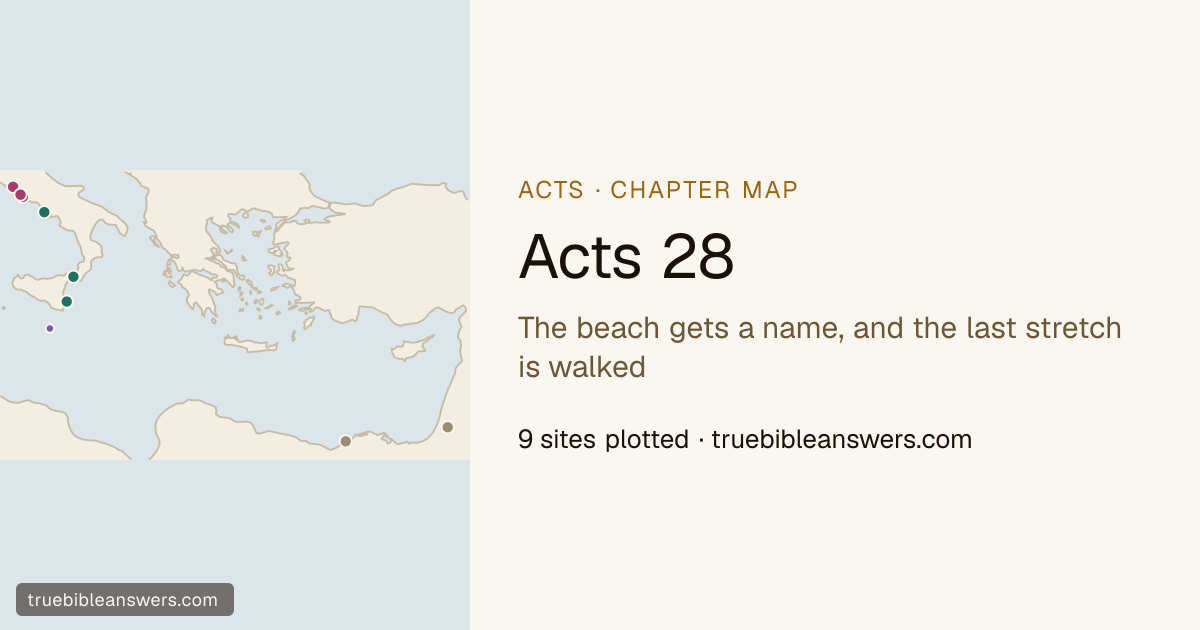
Regions on this map
Verses 1-10: the beach gets a name, and with it the storm's track gets an end. The ship is gone and the sea is shut for the winter, so the island keeps them until it opens.
The answer to the last chapter. Two hundred sea miles west of Cauda, and near enough to where a fortnight's drift before a north-easter would put a ship that the wreck is the strongest evidence the storm account came from someone aboard. Plotted at the island's centre.
Today: Malta (representative point)
Verses 11-13: a third ship, another Alexandrian, goes up the coast in short hops — three days at Syracuse, a day waiting at Rhegium, and then a south wind that does the rest in two.
Three days on the Sicilian coast. Luke records the stop and not the reason; a ship working north this early in the season waits where it can for a wind she can use.
Today: Siracusa, Sicily
The port Rome's grain came through, and where this voyage stops being a voyage: from here the city is a road. A week with the brothers found there, and then they walk.
Today: Pozzuoli, Italy
The toe of Italy, at a strait that has to be timed rather than merely sailed. They lay here a day, and the south wind that came up next morning made the last run possible.
Today: Reggio Calabria, Italy
Verses 14-16: the sea has finished with the story and the last stretch is walked. The two places named on that road are the two where Rome's Christians had come out to meet him.
The end of the journey, and the place the whole of the last chapter was aimed at without once naming. Luke says they came to it twice — once with the road still ahead of them, and again when they were actually inside it.
Today: Rome, Italy
A staging post on the Appian Way, forty-three Roman miles short of the city, where the first party out from Rome met the road. Not a place Paul chose to stop at but a distance somebody else was willing to walk.
Today: Foro Appio, Italy
Ten miles nearer Rome than the Forum, and the second group. Named together, the two of them measure how far a church that had never seen Paul came out to meet him.
Today: Tres Tabernae, near Cisterna di Latina
Places the chapter names for other reasons — where the last ship was registered, and the city and province at the far end of the chain Paul is still wearing.
Never visited, and named here for the second time in two chapters: the ship that finishes the voyage is from the same port as the one that was wrecked, and had sat out the winter in the same harbour.
Today: Alexandria, Egypt
Named in Paul's own account of how he came to be here: the city he was handed over in, at the far end of a map his case has now crossed from one side to the other.
Today: Jerusalem
The province the letters did not come from. Rome's Jewish leaders tell Paul they have had no word about him from home, which is the nearest the chapter comes to saying how far ahead of his own case he has travelled.
no point of its own; the gazetteer offers Jerusalem, which is on this map already
Acts 28, verse by verse
- Acts 28:1After we were brought safely through, we then learned that the island was called .
- Acts 28:11After three months we set sail in a ship that had wintered in the island, a ship of , with the twin gods as a figurehead.
- Acts 28:12Putting in at , we stayed there for three days.
- Acts 28:13And from there we made a circuit and arrived at . And after one day a south wind sprang up, and on the second day we came to .
- Acts 28:14There we found brothers and were invited to stay with them for seven days. And so we came to .
- Acts 28:15And the brothers there, when they heard about us, came as far as the and to meet us. On seeing them, Paul thanked God and took courage.
- Acts 28:16And when we came into , Paul was allowed to stay by himself, with the soldier who guarded him.
- Acts 28:17After three days he called together the local leaders of the Jews, and when they had gathered, he said to them, “Brothers, though I had done nothing against our people or the customs of our fathers, yet I was delivered as a prisoner from into the hands of the Romans.
- Acts 28:21And they said to him, “We have received no letters from about you, and none of the brothers coming here has reported or spoken any evil about you.
- Acts 28:30He lived there two whole years at his own expense, and welcomed all who came to him,