Acts 27: The course they set, and the course the wind gave them
Read it →Paul sails for Rome under guard, and the chapter is largely a record of where the weather permitted the ship to be. Two ships carry him: a coaster from Adramyttium as far as Myra, then an Alexandrian grain ship bound for Italy. Both are working the same problem — westerly winds in the last safe weeks of the sailing season — which is why the track takes the sheltered side of Cyprus, crawls as far as Cnidus, and slips under Crete at Salmone instead of running straight for Italy. At Fair Havens the argument is about a harbour, and the majority vote for Phoenix, forty miles west. They never reach it. A north-easter comes down off the Cretan hills in verse 14 and does not give the ship back for fourteen nights. After that the chapter can name only a small island called Cauda, a shoal they dread, and a sea they are somewhere in. It ends on a beach nobody aboard recognises — and the next chapter names it.
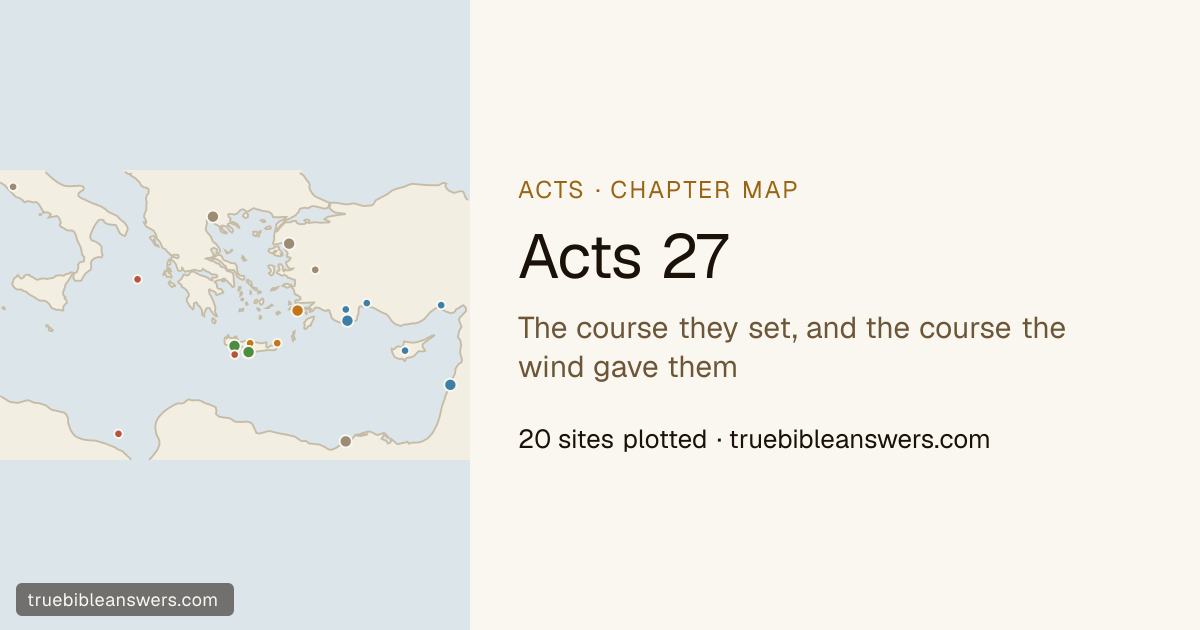
Regions on this map
Verses 1-5: a coaster out of Adramyttium works north and west with the wind against her, taking the sheltered side of Cyprus and the lee of the Cilician shore.
One day's run north from Caesarea, and the last kindness before the weather: Julius lets his prisoner go ashore to be cared for by friends.
Today: Saida, Lebanon
With the wind against them they took the sheltered side, passing east and north of the island instead of the direct run down its southern coast. Plotted at the island's centre.
Today: Cyprus (representative point)
The mainland north of Cyprus. Its westward current and its land breezes are the whole reason the long way round was the fast way.
Today: the Çukurova coast (point at Tarsus) (representative point)
The province Myra stands in, and the corner where coasting has to stop and the open crossing to Italy begins.
Today: south-west Turkey (representative point)
Where the two voyages are spliced. Myra was a regular landfall for the Alexandrian grain fleet, and the centurion transfers his prisoners onto one of its ships here.
Today: Demre, Turkey
The next stretch of that same sheltering coast, carrying them west towards Lycia.
Today: the Antalya coast (representative point)
Verses 6-8: a grain ship out of Alexandria makes Cnidus with difficulty, gives up the direct course to Italy, and runs down under Crete instead.
Days of slow work brought them level with this promontory port and no further. Beyond it the shelter of the coast runs out, and the wind decided the rest.
Today: Knidos, Turkey
The island the rest of the chapter turns on: shelter first, then the hills the north-easter comes down from. Plotted at its centre.
Today: Crete (representative point)
The eastern cape of Crete, rounded to get into the island's lee — the second time in one voyage that an island is used as a wind-break.
Today: Cape Sideros, Crete (representative point)
Verses 9-13: whether to winter in an open roadstead or run forty miles west to a better one. Paul says stay; the pilot, the owner and the majority say go.
An open roadstead on the south coast: good enough to lie in for weeks, exposed enough to argue about. Paul's advice was to stay, and he gives it as a passenger, not a prophet.
Today: Kaloi Limenes, Crete
Luke fixes the anchorage by the town beside it, a mile or so east. That aside is the reason Fair Havens can still be pointed at on a map today.
Today: Lasaea, Crete
The better winter harbour the majority voted for, and the one place on this map scholars still divide over — Loutro on the east of the headland, or Phoinikas on the west. They reached neither.
Today: Loutro or Phoinikas, Crete (disputed)
Verses 14-44: the wind takes the ship off Crete and keeps it for fourteen nights. From here the chapter can give a direction and a fear, but not a position.
A small island some twenty-three miles south-west of Crete, and the last piece of ground the ship could work in the lee of. Everything after it is open sea.
Today: Gavdos, Greece (representative point)
Not somewhere they went but the thing they were afraid of: the shoals off the North African coast, dead to leeward of a north-easter. Fear of them is why the gear came down and the ship was let drift.
Today: the Gulf of Sidra, Libya (representative point)
Adria in the first century meant the open sea between Crete, Sicily and Malta, not the gulf the name has since narrowed to. The point here is the gazetteer's; the ship was a long way south of it.
Today: the Ionian Sea (representative point)
Places the chapter names for other reasons — where a ship was registered, where a companion came from, and the Italy this voyage never reaches.
The destination, named in the first verse and again when the grain ship is found — and never reached in this chapter. Plotted at Rome, the far end of a voyage that ends on a beach in the next chapter.
Today: Italy (point at Rome) (representative point)
Not a port of call but the first ship's home town, on the Asian coast opposite Lesbos; she was working her way back towards it, which is why she could only be borrowed as far as Myra.
Today: Ören, Turkey, near Edremit
The Roman province the Adramyttian ship was coasting home through. It is her itinerary, not Paul's: his party leaves it at Myra.
Today: western Turkey (representative point)
Named for a passenger rather than a port: Aristarchus the Macedonian, who had travelled with Paul since Ephesus and is still on deck for the wreck.
Today: Thessaloniki, Greece
Never visited: the second ship's home port and the source of her cargo. The wheat thrown overboard in verse 38 is Egypt's, and it was owed to Rome.
Today: Alexandria, Egypt
Acts 27, verse by verse
- Acts 27:1And when it was decided that we should sail for , they delivered Paul and some other prisoners to a centurion of the Augustan Cohort named Julius.
- Acts 27:2And embarking in a ship of , which was about to sail to the ports along the coast of , we put to sea, accompanied by Aristarchus, a Macedonian from .
- Acts 27:3The next day we put in at . And Julius treated Paul kindly and gave him leave to go to his friends and be cared for.
- Acts 27:4And putting out to sea from there we sailed under the lee of , because the winds were against us.
- Acts 27:5And when we had sailed across the open sea along the coast of and , we came to in .
- Acts 27:6There the centurion found a ship of sailing for and put us on board.
- Acts 27:7We sailed slowly for a number of days and arrived with difficulty off , and as the wind did not allow us to go farther, we sailed under the lee of off .
- Acts 27:8Coasting along it with difficulty, we came to a place called , near which was the city of .
- Acts 27:12And because the harbor was not suitable to spend the winter in, the majority decided to put out to sea from there, on the chance that somehow they could reach , a harbor of , facing both southwest and northwest, and spend the winter there.
- Acts 27:13Now when the south wind blew gently, supposing that they had obtained their purpose, they weighed anchor and sailed along , close to the shore.
- Acts 27:14But soon a tempestuous wind, called the northeaster, struck down from the land.
- Acts 27:16Running under the lee of a small island called , we managed with difficulty to secure the ship's boat.
- Acts 27:17After hoisting it up, they used supports to undergird the ship. Then, fearing that they would run aground on the , they lowered the gear, and thus they were driven along.
- Acts 27:21Since they had been without food for a long time, Paul stood up among them and said, “Men, you should have listened to me and not have set sail from and incurred this injury and loss.
- Acts 27:27When the fourteenth night had come, as we were being driven across the , about midnight the sailors suspected that they were nearing land.