The twelve tribes of Israel: The land divided among the twelve tribes
Read it →Joshua 13–21 is the record of how the land was divided. Moses had already settled Reuben, Gad and half of Manasseh east of the Jordan; the other nine and a half tribes drew lots at Gilgal and then at Shiloh, and the text writes each portion out as a boundary traced landmark by landmark and a list of towns. Judah's share is described first and at the greatest length, Simeon's is carved out of the middle of it because Judah's was too large, and Dan's is so quickly lost that the tribe takes a town at the far northern end of the country instead. Levi is given no territory at all — forty-eight towns inside the other tribes' land, six of them cities of refuge. The outlines here follow the boundary the text names where it names one, and are deliberately blurred where it does not.
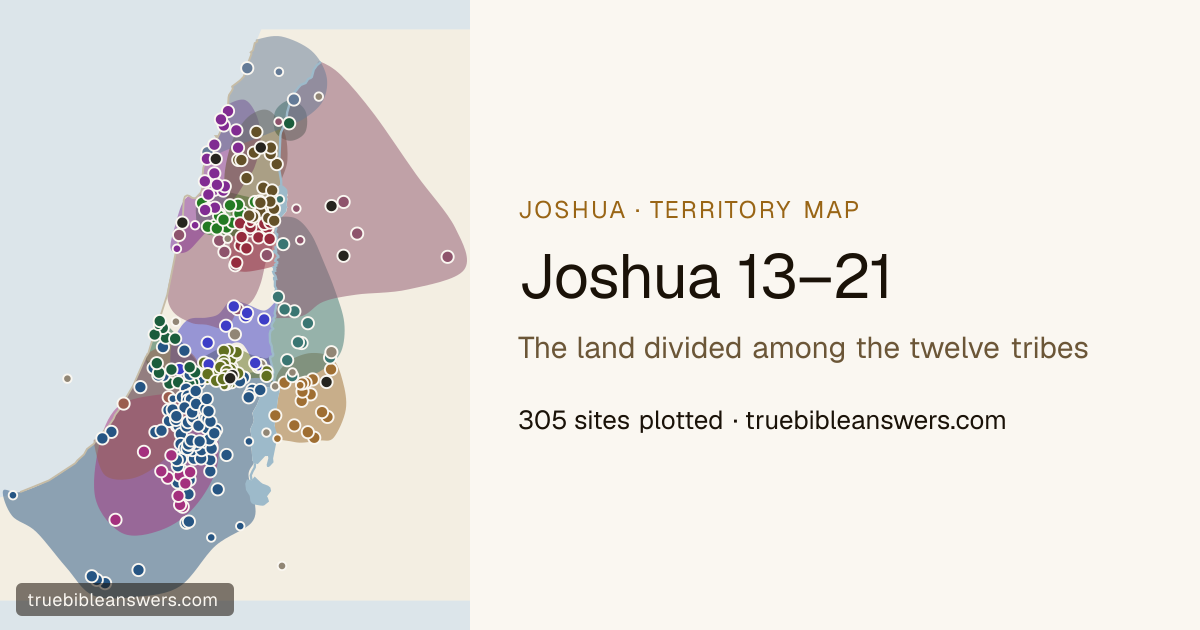
Regions on this map
West of the Jordan
Joshua 15. The first and largest allotment: the Salt Sea on the east, the Great Sea on the west, the Brook of Egypt and Kadesh-barnea in the far south, and a northern border traced spring by spring past Jerusalem. Four town districts follow — the Negeb, the lowland, the hill country and the wilderness.
A Philistine lordship listed among the land still to be taken (13:3) and then written into Judah's town list with its villages (15:47); Judah is where the allotment puts it.
Today: Tel Ashdod
The southernmost Philistine lordship (13:3), and named again with its towns and villages in Judah's list (15:47), which is why it is drawn as Judah's.
Today: Tell Harube
The oasis Caleb was sent out from forty-five years earlier (14:6-7), and the point Judah's south boundary runs "up south of" (15:3).
Today: Ain el Qudeirat
Caleb's inheritance, given him out of Judah (14:13) and listed among Judah's hill-country towns (15:54); a city of refuge (20:7) and the first town given to Aaron's sons (21:11-13), while its fields stayed Caleb's (21:12).
Today: Tel Rumeida
The dry south, the country Achsah's springs lay in (15:19) and the district Judah's first town list belongs to (15:21).
the dry south as a whole; the point the sources give it is Beersheba's own tell, already a pin here
The wilderness at the far southern end of Judah's allotment (15:1), where the boundary begins.
Today: Zin Desert (representative point)
A point on Judah's south boundary between Hezron and Karka (15:3); no site is identified.
no site identified; the sources place it only on Judah's south line near Kadesh-barnea
The "ascent of Akrabbim", the scorpion pass climbing out of the Arabah, where Judah's south boundary turns west (15:3).
Today: Ma’ale Akrabbim (representative point)
A point on Judah's south boundary (15:3), unlocated and not to be confused with the Hezron of Judah's genealogy.
no site identified; the sources place it only on Judah's south line near Kadesh-barnea
A turn in Judah's south boundary between Addar and Azmon (15:3); the identification with Ain Qoseimeh is a guess.
Today: Ain Qoseimeh
The same wilderness of Zin, named again as the boundary "passes along to Zin" (15:3).
the same wilderness the pin for Zin already stands on
The last named point before Judah's south boundary drops to the Brook of Egypt (15:4).
Today: Ain Muweileh
The wadi that carries Judah's south boundary out to the sea (15:4) and closes its coastal district (15:47) — the Wadi el-Arish, on the desert edge.
Today: Wadi al Arish (representative point)
A point on Judah's north boundary above the Valley of Achor (15:7) — not the Debir of the hill country that Othniel took.
Today: Thoghret ed Debr
A Gilgal on Judah's north boundary opposite the ascent of Adummim (15:7) — Benjamin's border calls the same point Geliloth (18:17), and it is not the Gilgal of the camp by the Jordan.
Today: Araq ed Deir
The valley where Achan was stoned, used here as the point Judah's north boundary climbs from (15:7).
Today: Al Buqay’ah (representative point)
The name Judah's border uses for Kiriath-jearim (15:9-10).
the same town as Kiriath-jearim; one pin serves both
"The cities of Mount Ephron", a ridge on Judah's north boundary before it bends to Kiriath-jearim (15:9).
Today: Al Qastal
Judah's north boundary goes down to it (15:10); Joshua 21:16 gives it to Aaron's sons out of Judah.
Today: Tel Bet Shemesh
The town on the northern shoulder of Mount Jearim, on Judah's north boundary (15:10).
Today: Kesla
The ridge the boundary passes along, which 15:10 says is Chesalon.
the ridge Chesalon stands on; one pin serves both
A hill west of Kiriath-jearim on Judah's north boundary (15:10) — not the Seir of Edom.
Today: Shoresh
The last named point on Judah's north boundary before it reaches the sea (15:11).
Today: Yibna
A low hill on Judah's north-western boundary between Shikkeron and Jabneel (15:11).
Today: Mughar
A bend in Judah's north boundary north of Ekron (15:11).
Today: Tell el Ful
The hill-country town Othniel took for Achsah's hand (15:15-17), formerly Kiriath-sepher, listed among Judah's towns as Kiriath-sannah (15:49) and given to the Levites (21:15).
Today: Khirbet Rabud
The "springs of water" Achsah asked her father for (15:19); the sources place them at Debir's own site.
the springs at Debir; one pin serves all three
The lower of the two springs Caleb gave Achsah (15:19).
the springs at Debir; one pin serves all three
The upper of the two springs Caleb gave Achsah (15:19).
the springs at Debir; one pin serves all three
One of Judah's twenty-nine southernmost towns (15:21); the sources put it at Tel Arad.
Today: Tel Arad
One of Judah's twenty-nine southernmost towns (15:21).
Today: Tel Ira
First of the twenty-nine towns Judah held in the extreme south, toward the boundary of Edom (15:21).
Today: Khirbet Hora
One of Judah's twenty-nine southernmost towns (15:22).
Today: Khirbet Aro’er
One of Judah's twenty-nine southernmost towns (15:22); the sources' best guess for it is Dibon's tell, far east of Judah.
no site identified in Judah; the point the sources give it is Dibon's own tell, already a pin here
One of Judah's twenty-nine southernmost towns (15:22), on a wadi east of Beersheba.
Today: Wadi el Qeini (representative point)
One of Judah's twenty-nine southernmost towns (15:23) — one of four Hazors in Judah's list alone.
Today: El Jebariyeh
One of Judah's twenty-nine southernmost towns (15:23), with the weakest identification in the district.
no site identified; the sources place it only beside the Hazor of 15:23
One of Judah's twenty-nine southernmost towns (15:23); read by many as Kadesh-barnea, which is where the sources put it.
no separate site identified; the sources place it at Kadesh-barnea, already a pin here
One of Judah's twenty-nine southernmost towns (15:24); the sources place it far north of the district, at Chesalon's site.
no site identified in the south; the point the sources give it is Chesalon's, already a pin here
One of Judah's twenty-nine southernmost towns (15:24).
Today: Khirbet Umm es Salafe
One of Judah's twenty-nine southernmost towns (15:24) — not the Ziph of the hill country where David hid.
Today: Khirbet ez Zeifeh
The Hazor of 15:25, which the verse itself identifies with Kerioth-hezron.
Today: Khirbet el Qaryatein
"New Hazor", one of Judah's twenty-nine southernmost towns (15:25).
Today: Har Hezron
Named in 15:25 with the note "that is, Hazor" — the same town as the Hazor of that verse.
the same town as the Hazor of 15:25; one pin serves both
One of Judah's twenty-nine southernmost towns (15:26).
Today: Be’er Nevatim
One of Judah's twenty-nine southernmost towns (15:26); no site is identified.
no site identified; the sources place it only in the Beersheba basin
One of Judah's twenty-nine southernmost towns (15:27).
Today: Tell es Saqati
One of Judah's twenty-nine southernmost towns (15:27); no site is identified.
no site identified; the sources place it only in the Beersheba basin
One of Judah's twenty-nine southernmost towns (15:27); no site is identified.
no site identified; the sources place it only in the Beersheba basin
Named with Beersheba in 15:28; no site is identified, and the Greek text reads the word as "and its villages" rather than as a place.
no site identified
One of Judah's twenty-nine southernmost towns (15:29); Simeon's list calls the same place Balah (19:3).
the same town as Simeon's Balah; one pin serves both
One of Judah's twenty-nine southernmost towns (15:29).
Today: Deir al Ghawi
One of Judah's twenty-nine southernmost towns (15:30); the sources place it at Beth-zur's site in the hill country.
no site identified in the south; the point the sources give it is Beth-zur's, already a pin here
One of Judah's twenty-nine southernmost towns (15:31); Simeon's Beth-marcaboth is placed at the same site.
Today: Khirbet Tatrit
One of Judah's twenty-nine southernmost towns (15:31); Simeon's Hazar-susah is placed at the same site.
Today: Khirbet esh Shamsaniyat
One of Judah's twenty-nine southernmost towns (15:32); Simeon's list calls it Beth-lebaoth (19:6).
the same town as Simeon's Beth-lebaoth; one pin serves both
One of Judah's twenty-nine southernmost towns (15:32); Simeon's Sharuhen is placed at the same site.
Today: Tall al Ajjul
One of the fourteen lowland towns of Judah's first Shephelah group (15:33).
Today: Islin
"The lowland" — the foothill belt between the hill country and the coast, and the district heading for Judah's next thirty-nine towns (15:33).
Today: Shephelah (representative point)
One of the fourteen lowland towns (15:34), placed by the sources in the Valley of Elah.
Today: Valley of Elah (representative point)
One of the fourteen lowland towns (15:34) — not the En-gannim of Issachar.
Today: Khirbet Umm Jina
One of the fourteen lowland towns (15:34) — not the Tappuah on the Ephraim–Manasseh border.
Today: Bayt Nattif
One of the fourteen lowland towns (15:34), in the Sorek valley.
Today: Khirbet Zanu
One of the fourteen lowland towns (15:35); the cave David hid in was in its country.
Today: Khirbet esh Sheikh Madhkur
One of the fourteen lowland towns (15:35), the hill Israel chased the five kings past.
Today: Tel Azekah
One of the fourteen lowland towns (15:35); its king was one of the five who besieged Gibeon.
Today: Tel Yarmuth
One of the fourteen lowland towns (15:35), at the mouth of the Elah valley.
Today: Tel Socho
One of the fourteen lowland towns (15:36).
Today: Al Haditha
One of the fourteen lowland towns (15:36); many read "Gederah and Gederothaim" as a single name, which is where the sources put both.
read by many as one name with Gederothaim; one pin serves both
Named with Gederah at the end of the fourteen (15:36), and probably the same town.
Today: Khirbet Judraya
One of the fourteen lowland towns (15:36), above the Elah valley.
Today: Khirbet es Sira
One of the sixteen lowland towns (15:37); the sources fix it only as lying between Lachish and Gath.
Today: between Lachish and Gath (representative point)
One of the sixteen lowland towns (15:37).
Today: Khirbet el Mejdeleh
One of the sixteen towns of Judah's second lowland group (15:37).
no site identified; the sources place it only beside Lachish
One of the sixteen lowland towns (15:38).
Today: Tel Nagila
One of the sixteen lowland towns (15:38).
no site identified; the sources place it only beside Lachish
One of the sixteen lowland towns (15:38) — not the Mizpeh of Benjamin.
no site identified; the sources place it only beside Dilean
One of the sixteen lowland towns (15:39); King Josiah's mother came from here.
Today: Ed Dawaimeh
One of the sixteen lowland towns (15:39); its king was one of the five Joshua hanged.
Today: Tell Eton
One of the sixteen lowland towns (15:39), and the greatest fortress of the Shephelah.
Today: Tell ed Duweir
One of the sixteen lowland towns (15:40).
no site identified; the sources place it only beside Madmannah
One of the sixteen lowland towns (15:40).
Today: Khirbet Makhaz
One of the sixteen lowland towns (15:40).
Today: Horbat Lehem
One of the sixteen lowland towns (15:41) — a Philistine god's name on a Judahite town.
Today: Khirbet Dajun
One of the sixteen lowland towns (15:41).
Today: Qatra
Last of the sixteen lowland towns (15:41), and the cave the five kings hid in.
Today: Khirbet el Qom
One of the sixteen lowland towns (15:41).
no site identified; the sources place it only beside Lachish
One of the nine lowland towns (15:42); Simeon's list has an Ether too (19:7), and the sources put them at one site.
Today: Khirbet el Ater
First of the nine towns of Judah's third lowland group (15:42), given to Aaron's sons in 21:13.
Today: Tell Bornat
One of the nine lowland towns (15:43) — a second Ashnah, ten miles from the first.
Today: Idhna
One of the nine lowland towns (15:43).
Today: Tarqumiyeh
One of the nine lowland towns (15:43).
Today: Khirbet Beit Nesib esh Sharqiyyeh
One of the nine lowland towns (15:44) — not the Achzib of Asher's coast.
Today: Tel el Beida
One of the nine lowland towns (15:44); David relieved its threshing floors from the Philistines.
Today: Khirbet Qila
Last of the nine lowland towns (15:44), fortified by Rehoboam.
Today: Tel Maresha
One of the eleven hill-country towns (15:48), given to Aaron's sons in 21:14.
Today: Khirbet Attir
First of the eleven towns of Judah's hill country (15:48).
Today: Khirbet al Bira
One of the eleven hill-country towns (15:48) — a second Socoh, south of Hebron.
Today: Khirbet Shuweikah
One of the eleven hill-country towns (15:49).
no site identified; the sources place it only beside the Ashnah of 15:43
One of the eleven hill-country towns (15:50), taken from the Anakim in Joshua 11.
Today: Khirbet Anab es Seghireh
One of the eleven hill-country towns (15:50).
Today: Horbat Anim
One of the eleven hill-country towns, spelled Eshtemoh in 15:50 and given to Aaron's sons in 21:14.
Today: As Samu
Last of the eleven hill-country towns (15:51); Ahithophel came from here.
no site identified; the sources place it only at Debir's site
One of the eleven hill-country towns (15:51) — the Goshen of Judah, not the Goshen of Egypt.
Today: Dahriya
One of the eleven hill-country towns (15:51), given to Aaron's sons in 21:15.
Today: Khirbet Alin
One of the nine towns of Judah's second hill-country group (15:52).
Today: Khirbet er Rabiyeh
One of the nine hill-country towns (15:52).
Today: Deir ed Domeh
One of the nine hill-country towns (15:52).
Today: Khirbet Khallat Sam’a
One of the nine hill-country towns (15:53).
Today: Khirbet al Hadab
One of the nine hill-country towns (15:53), just north-west of Hebron.
Today: Taffuh
One of the nine hill-country towns (15:53).
Today: Bani Nai’im
One of the nine hill-country towns (15:54).
no site identified; the sources place it only at Hebron
Last of the nine hill-country towns (15:54).
no site identified; the sources place it only at Hebron
One of the ten hill-country towns (15:55) — the Carmel of Judah, not the mountain on Asher's coast.
Today: Khirbet el Kirmil
One of the ten hill-country towns (15:55), given to Aaron's sons in 21:16.
Today: Yatta
One of the ten towns of Judah's third hill-country group (15:55); Nabal's flocks were here.
Today: Tel Main
One of the ten hill-country towns (15:55); its wilderness is where David hid from Saul.
Today: Tell Zif
One of the ten hill-country towns (15:56) — Ahinoam's town, and not the Jezreel of the northern valley.
no site identified; the sources place it only at Juttah
One of the ten hill-country towns (15:56).
Today: Khirbet er Raqqa
One of the ten hill-country towns (15:56) — a second Zanoah, south of Hebron.
no site identified; the sources place it only south of Hebron
One of the ten hill-country towns (15:57) — not Saul's Gibeah in Benjamin.
Today: south of Hebron (representative point)
One of the ten hill-country towns (15:57).
Today: Khirbet Bani Dar
Last of the ten hill-country towns (15:57) — a second Timnah, in the hills rather than the Sorek valley.
no site identified; the sources place it only at Maon
One of the six hill-country towns (15:58), on the watershed road; Rehoboam fortified it.
Today: Khirbet et Tubeiqa
One of the six hill-country towns (15:58).
Today: Khirbet Jedur
One of the six towns of Judah's fourth hill-country group (15:58), just north of Hebron.
Today: Halhul
One of the six hill-country towns (15:59).
Today: Khirbet Beit Anun
Last of the six hill-country towns (15:59).
Today: Khirbet ed Deir
One of the six hill-country towns (15:59).
Today: Khirbet Qufin
The second of the two towns of 15:60, listed with Kiriath-baal — not the Ammonite Rabbah east of the Jordan.
Today: Khirbet Hamideh
One of the six towns of Judah's wilderness district, along the cliffs above the Dead Sea (15:61).
Today: Khirbet Abu Tabaq
One of the six wilderness towns (15:61).
Today: Khirbet es Samrah
One of the six wilderness towns (15:62); the sources place it at Qumran.
Today: Qumran
Last of the six wilderness towns (15:62) — the spring and oasis halfway down the western shore of the Dead Sea.
Today: Ein Gedi (representative point)
One of the six wilderness towns (15:62).
Today: Khirbet el Maqari
Joshua 19:1–9. The second lot, and the only one drawn inside another: "their inheritance was in the midst of the inheritance of the people of Judah", because Judah's portion was too large. Seventeen of Simeon's twenty entries stand on ground Judah's own Negeb list in Joshua 15 already claims.
Listed among Judah's southernmost towns (15:26) and then given to Simeon (19:2), whose portion was taken out of Judah's.
Today: Khirbet el Waten
The best-known town of the Negeb, in Judah's southern list (15:28) and first in Simeon's (19:2) — Simeon's portion was carved out of Judah's, and this is its centre.
Today: Tel Beer Sheva
Listed among Judah's southernmost towns (15:28) and then given to Simeon (19:3); no site is identified.
no site identified; the sources place it only in the Beersheba basin
Listed among Judah's southernmost towns (15:29) and then given to Simeon (19:3).
Today: Umm el Azam
Listed among Judah's southernmost towns (15:30) and then given to Simeon (19:4).
Today: Khirbet Erqa Saqra
The town Israel had been driven back from in the wilderness; in Judah's southern list (15:30) and then Simeon's (19:4).
Today: Tel Masos
In Judah's southern list (15:31) and then Simeon's (19:5); the Philistine king of Gath later gave it to David.
Today: Tell esh Sharia
Last but one of Judah's southern towns (15:32) and then Simeon's (19:7); often read with Rimmon as a single name, En-rimmon.
Today: Khirbet Umm er Rammamin
Named beside Ain in both lists (15:32, 19:7) and usually read with it as one town, En-rimmon.
read with Ain as one town, En-rimmon; one pin serves both
In Judah's lowland list (15:42) and then Simeon's (19:7); Joshua 21:16's Ain is placed at the same site.
Today: Khirbet Asan
One of Simeon's thirteen towns (19:2), named beside Beersheba.
Today: Tel Yeshua
One of Simeon's thirteen towns (19:3); Judah's list calls the same place Baalah (15:29).
Today: Tulul el Medbah
One of Simeon's thirteen towns (19:4).
no site identified in the Negeb; the point the sources give it is Beth-zur's, far to the north and already a pin here
"House of chariots", one of Simeon's thirteen towns (19:5).
no site identified; the sources place it at Madmannah, already a pin here
"Horse enclosure", one of Simeon's thirteen towns (19:5).
no site identified; the sources place it at Sansannah, already a pin here
One of Simeon's thirteen towns (19:6); Judah's list calls it Lebaoth (15:32).
Today: Jebel el Biri
Last of Simeon's thirteen towns (19:6), an Egyptian fortress in the earlier records.
the sources place it at the same tell as Judah's Shilhim, already a pin here
One of Simeon's four remaining towns (19:7); Judah's lowland list has an Ether too (15:42).
the same site as Judah's Ether; one pin serves both
The limit of Simeon's villages, "Ramah of the Negeb" (19:8).
the sources place it at the same tell as Balah, already a pin here
"Ramah of the Negeb", the second name 19:8 gives Baalath-beer.
the best-scored point the sources give for the name is Kiriath-jearim's tell in the hill country, which cannot be the Negeb town
Joshua 18:11–28. The first lot cast at Shiloh, and the smallest western portion: a strip "between the people of Judah and the people of Joseph", from the Jordan at Jericho west to Kiriath-jearim, with twenty-six towns.
Used through the span as a direction — "beyond the Jordan of Jericho" (13:32), "east of the waters of Jericho" (16:1) — and then listed as the first of Benjamin's own towns (18:21).
Today: Tell es Sultan
On Judah's north boundary (15:6) and among Judah's wilderness towns (15:61), but listed again in Benjamin's own twelve (18:22); the later list is the one that allots it.
Today: Ain el Gharabeh
A boundary town shared by Judah's north line (15:6) and Benjamin's south (18:19), and listed among Benjamin's twelve cities (18:21).
Today: Deir Hajla
The "ascent of Adummim", the climb from Jericho to Jerusalem, used to fix the same stretch of border from both sides (15:7, 18:17).
Today: Adummim (representative point)
The spring below Jerusalem where Judah's north boundary ends (15:7) and Benjamin's south boundary turns (18:16-17).
Today: Bir Ayub
"The waters of En-shemesh" on the Jerusalem–Jericho border, traced from both sides (15:7, 18:17).
Today: Ein Haud
The older name of Jerusalem, given in Benjamin's own town list (18:28) and used for the city Judah's border skirts (15:8).
the same city as Jerusalem; one pin serves both
Judah's north boundary runs past its southern shoulder (15:8) and Judah could not drive out its Jebusites (15:63) — but the town list that allots it is Benjamin's (18:28), which is why it is drawn as Benjamin's.
Today: Jerusalem
The ravine on Jerusalem's south-west side, the hinge of the Judah–Benjamin border (15:8, 18:16).
Today: Hinnom Valley (representative point)
The plain south-west of Jerusalem whose northern end both border traces use as a fixed point (15:8, 18:16).
Today: Valley of Rephaim (representative point)
The corner where Benjamin's western side ends (18:14) and its southern side begins (18:15); called Baalah and Kiriath-baal on Judah's side of the same line (15:9, 15:60), and listed last among Benjamin's fourteen towns (18:28).
Today: Deir el Azar
The spring both border traces run to (15:9, 18:15), on the watershed north-west of Jerusalem.
Today: Lifta
Joseph's boundary climbs to it out of the wilderness (16:1-2) and Benjamin's runs down past its shoulder (18:13), but the town list that allots it is Benjamin's (18:22).
Today: Beitin
The older name of Bethel, which 18:13 states outright.
the same town as Bethel; one pin serves both
The lower of the two towns on the pass down to the coastal plain: the limit of Joseph's border (16:3) and the hill south of it fixes Benjamin's (18:13).
Today: Beit Ur al Tahta
A boundary point named from both sides — Ephraim's east border (16:5) and Benjamin's north (18:13).
no site identified; the sources place it at Mizpeh's tell, already a pin here
The wilderness Benjamin's northern boundary ends at, west of Jericho (18:12).
Today: Tell Maryam
The plain name of the pass, used to fix Benjamin's western side (18:14) and given to the Levites out of Ephraim (21:22).
the sources resolve the plain name to Lower Beth-horon, already a pin here
A point on Benjamin's southern boundary between Kiriath-jearim and the spring of Nephtoah (18:15).
no separate site identified; the sources place it at Mount Ephron, already a pin here
The name Benjamin's boundary gives the point opposite the ascent of Adummim (18:17) that Judah's calls Gilgal (15:7).
the same point Judah's border calls Gilgal; one pin serves both
The rift floor Benjamin's southern boundary goes down to past Beth-arabah (18:18).
the rift valley itself; the representative point the sources give lies far to the south, outside this frame
The third of Benjamin's twelve cities (18:21); no site is identified.
no site identified; the sources place it at Jericho's tell, already a pin here
One of Benjamin's twelve northern cities (18:22).
Today: Ras ez Zemara
One of Benjamin's twelve northern cities (18:23) — a town, not the Avvim of the Philistine coast in 13:3.
Today: Et Tell
One of Benjamin's twelve northern cities (18:23).
Today: Taybeh
One of Benjamin's twelve northern cities (18:23), in the wadi east of Jerusalem.
Today: Khirbet Ein Fara
One of Benjamin's twelve northern cities (18:24).
Today: Khirbet Kafr Ana
Last of Benjamin's twelve northern cities (18:24), on the ravine facing Michmash; 21:17 gives it to the Levites out of Benjamin.
Today: Jaba
One of Benjamin's twelve northern cities (18:24).
Today: Jifna
One of Benjamin's fourteen southern cities (18:25), and one of the four Gibeonite towns.
Today: Al Bira
First of Benjamin's fourteen southern cities (18:25) — the town whose treaty had drawn Joshua into the southern campaign; a Levitical town in 21:17.
Today: El Jib
One of Benjamin's fourteen southern cities (18:25), on the watershed road north of Jerusalem.
Today: Al Ram
One of Benjamin's fourteen southern cities (18:26), another of the four Gibeonite towns.
Today: Khirbet el Kefireh
One of Benjamin's fourteen southern cities (18:26), later the place Israel assembled at.
Today: Tell en Nasbeh
One of Benjamin's fourteen southern cities (18:26), in the valley west of Jerusalem.
Today: Qalunya
One of Benjamin's fourteen southern cities (18:27).
Today: Rafat
One of Benjamin's fourteen southern cities (18:27); no site is identified.
no site identified; the sources place it beside Irpeel
One of Benjamin's fourteen southern cities (18:27).
Today: Khirbet Erha
One of Benjamin's fourteen southern cities (18:28) — Saul's Gibeah.
Today: Tel el Ful
One of Benjamin's fourteen southern cities (18:28); no site is identified.
no site identified; the sources place it beside Zela
One of Benjamin's fourteen southern cities (18:28); Saul and Jonathan were buried in its family tomb.
Today: Khirbet Salah
Joshua 19:40–48. The seventh and last lot cast at Shiloh: the coastal plain and the Sorek valley, from Zorah and Eshtaol down to Joppa. Verse 47 records that the tribe lost it.
The northernmost Philistine capital: unconquered in 13:3, a marker on Judah's north boundary in 15:11, listed with Judah's towns in 15:45 — and then given to Dan in 19:43, which is the last word the span says about it.
Today: Tel Miqne
A point on Judah's north boundary (15:10) and then one of Dan's towns (19:43); Samson's Timnah.
Today: Tel Batash
Listed first among Judah's lowland towns (15:33) and then in Dan's territory (19:41); Samson's people came from here and from Zorah.
Today: Eshtaol
In Judah's lowland list (15:33) and then Dan's (19:41); the town the Danite spies of Judges 18 set out from.
Today: Tel Tzora
One of Dan's towns (19:41) — the same place Judah's north boundary goes down to as Beth-shemesh (15:10).
the same town as Beth-shemesh; one pin serves both
One of Dan's towns (19:42), in the valley Joshua had told the moon to stand still over; 21:24 gives it to the Levites out of Dan.
Today: Yalo
One of Dan's towns (19:42).
no site identified; the sources place it at Aijalon, already a pin here
One of Dan's towns (19:42); Judges 1:35 says the Amorites persisted in it.
Today: Salbit
One of Dan's towns (19:43).
no site identified; the sources place it at Aijalon, already a pin here
One of Dan's towns (19:44).
Today: Al Maghar
One of Dan's towns, spelled Elteke in 21:23 where it is given to the Levites out of Dan.
Today: Tel Shalaf
One of Dan's towns (19:44); 21:23 gives it to the Levites out of Dan.
Today: Tell Melat
One of Dan's towns (19:45).
Today: Al Khayriyya
One of Dan's towns (19:45); 21:24 gives it to the Levites out of Dan.
Today: Tel Gerisa
One of Dan's towns (19:45), on the plain behind Joppa.
Today: Yehud
The port Dan's territory is measured "over against" (19:46) — the only natural harbour on this coast, and the edge of the land Dan lost.
Today: Jaffa
One of the two waters closing Dan's list (19:46) — the Yarkon, the northern edge of Dan's plain.
Today: Yarkon River (representative point)
Named with Me-jarkon at the end of Dan's list (19:46), by the Yarkon mouth.
Today: Tell er Reqqeit
Joshua 19:47. "When the territory of the people of Dan was lost to them, the people of Dan went up and fought against Leshem … calling Leshem, Dan." The same tribe, at the opposite end of the country; Judges 18 tells the move at length. Drawn in Dan's colour because it is Dan, and drawn separately because it is not the allotment.
Leshem, taken and renamed when Dan's own territory was lost (19:47) — the tribe's second home, at the head of the Jordan and a hundred and fifty kilometres from the land it was allotted.
Today: Tel Dan
Joshua 16:5–10. The younger son of Joseph, in the hill country north of Benjamin: east to the Jordan at Jericho, north past Michmethath and Taanath-shiloh, and west from Tappuah along the brook Kanah. Verse 9 adds towns set apart for Ephraim inside Manasseh.
The spring at Jericho that Joseph's allotment is measured east of (16:1) — the start of the whole western boundary description.
Today: Ein as Sultan
A point on Joseph's southern boundary in the territory of the Archites (16:2).
no site identified; the sources place it at Mizpeh's tell, already a pin here
The end of Joseph's boundary at the sea road (16:3); 16:10 says Ephraim never drove out its Canaanites, and 21:21 gives it to the Levites out of Ephraim.
Today: Tel Gezer
The upper town of the pass, the limit of Ephraim's eastern boundary (16:5).
Today: Beit Ur al Fauqa
Ephraim's northern boundary passes beyond it on the east and then goes down from it (16:6-7).
Today: Khirbet Yanun
A turn eastward in Ephraim's northern boundary (16:6).
Today: Khirbet Tana el Fauqa
A second Ataroth, on Ephraim's boundary as it drops toward the Jordan (16:7).
Today: Tel al Mazar
The last named point before Ephraim's boundary touches Jericho and ends at the Jordan (16:7).
Today: Tell el Jisr
The town Ephraim's boundary runs west from (16:8); 17:8 splits the difference in one sentence — "The land of Tappuah belonged to Manasseh, but the town of Tappuah on the boundary of Manasseh belonged to the people of Ephraim."
Today: Tell Abu Zarad
A Manassite clan bears its name (17:2) and Manasseh's boundary is fixed east of it (17:7), but 20:7 puts it "in the hill country of Ephraim" as a city of refuge and 21:21 gives it to the Levites out of Ephraim.
Today: Tell Balatah
The town Joshua asked for and was given when the dividing was finished (19:50), spelled Timnath-serah there; it is in the hill country of Ephraim.
Today: Khirbet Tibnah
Joshua 17:1–18. The other half of Joseph's firstborn, and the only tribe with land on both banks: ten portions west of the river besides Gilead and Bashan east of it. Beth-shean, Ibleam, Dor, En-dor, Taanach and Megiddo are named as Manasseh's inside Issachar's and Asher's ground, and verse 12 says Manasseh could not take them.
The point on the Ephraim–Manasseh line named from both sides: the north of Ephraim's border (16:6) and the reach of Manasseh's territory "from Asher to Michmethath, which is east of Shechem" (17:7).
Today: Khirbet Ibn Naser
The spring the boundary of Manasseh runs south to (17:7), at the same site as the town of Tappuah that 17:8 gives to Ephraim.
the spring at Tappuah; one pin serves both
First of the six towns 17:11 says Manasseh had inside Issachar and Asher, and 17:12 says Manasseh could not take; its Canaanites had chariots of iron (17:16).
Today: Tel Bet Shean
One of the six towns of 17:11, on the coast south of Carmel; Manasseh never dispossessed its inhabitants.
Today: Tel Dor
One of the six towns of 17:11; Saul went to its medium the night before Gilboa.
Today: Khirbet es Safsafa
One of the six towns Manasseh held on paper inside Issachar and Asher (17:11) and could not take (17:12).
Today: Khirbet Belameh
Last of the six towns of 17:11, holding the pass through Carmel; Manasseh could not take it (17:12).
Today: Tel Megiddo
"The third is Naphath" (17:11) — the heights of Dor, the district the town stands in.
the district around Dor; one pin serves both
One of the six towns of 17:11, on the southern rim of the Jezreel plain; 21:25 gives it to the Levites out of half-Manasseh.
Today: Tell Ta’anakh
Joshua 19:17–23. The fourth lot: the Jezreel valley and the hills above it, sixteen towns, with the boundary touching Tabor and ending at the Jordan.
Zebulun's boundary runs up to it (19:12), but 21:28 gives it to the Levites "out of the tribe of Issachar", which is the last word the span says about whose it is.
Today: Horvat Devora
One of Issachar's sixteen cities (19:18); Zebulun's boundary calls the same town Chisloth-tabor (19:12).
Today: Iksal
First of Issachar's sixteen cities (19:18), on the spur above the valley that carries its name.
Today: Tel Yizre’el
One of Issachar's sixteen cities (19:18); the Philistines camped here before Gilboa.
Today: Sulam
One of Issachar's sixteen cities (19:19).
Today: Tell Rekhesh
One of Issachar's sixteen cities (19:19).
Today: Et Taiyibeh
One of Issachar's sixteen cities (19:19).
Today: Sirin
One of Issachar's sixteen cities (19:20); the identification is weak.
Today: Ain el Habus
One of Issachar's sixteen cities (19:20); 21:28 gives it to the Levites out of Issachar.
Today: Tell Qisyon
One of Issachar's sixteen cities (19:20).
no site identified; the sources place it at Daberath, already a pin here
One of Issachar's sixteen cities (19:21).
no site identified; the sources place it beside En-haddah
One of Issachar's sixteen cities (19:21), at the head of the valley road; 21:29 gives it to the Levites out of Issachar.
Today: Tell Jenin
One of Issachar's sixteen cities (19:21).
Today: Hadita
One of Issachar's sixteen cities (19:21); 21:29 calls the same place Jarmuth and gives it to the Levites.
Today: Kokab el Hawa
The last point Issachar's boundary touches before ending at the Jordan (19:22) — one of three Beth-shemeshes in this span.
Today: Sheikh esh Shamsawi
The isolated dome the boundary of Issachar touches (19:22), and the muster point of Deborah's army.
Today: Jebel et Tur
A point Issachar's boundary touches on its way to the Jordan (19:22); the identification is weak.
Today: El Karm
Joshua 19:10–16. The third lot: twelve towns in lower Galilee between Asher and Issachar, traced from Sarid out to Jokneam and back east to Gath-hepher. The list never reaches the sea.
The point Zebulun's territory reaches to and its boundary is traced from in both directions (19:10, 19:12).
Today: Tel Shadud
A point on Zebulun's western boundary (19:11).
Today: Tel Shem
The brook east of it fixes Zebulun's western boundary (19:11); 21:34 gives the town to the Levites out of Zebulun.
Today: Tel Yokneam
A point on Zebulun's western boundary (19:11).
Today: Tell Thorah
The boundary Zebulun's eastern line runs to (19:12) — the same town Issachar's list calls Chesulloth (19:18).
the same town as Issachar's Chesulloth; one pin serves both
A point on Zebulun's eastern boundary above the Jezreel plain (19:12).
Today: Yafa
A point on Zebulun's eastern boundary (19:13); the identification is weak.
Today: Kefr Kenna
A point on Zebulun's eastern boundary (19:13); Jonah the prophet came from here.
Today: Tel Gat Hefer
The bend in Zebulun's boundary before it turns north to Hannathon (19:13-14).
Today: Nimrin
The boundary goes on to it and bends toward Neah (19:13); 21:35's Dimnah is read as the same town.
Today: Rumana
The northern turn of Zebulun's boundary (19:14).
Today: Tel Hanaton
Last of Zebulun's twelve cities (19:15) — the northern Bethlehem, not Judah's.
Today: Beit Lahm
One of Zebulun's twelve cities (19:15).
Today: Khirbet el Huwarah
One of Zebulun's twelve cities (19:15).
Today: Tel Far
One of Zebulun's twelve cities (19:15); 21:35 gives it to the Levites out of Zebulun.
Today: Tel Nahal
One of Zebulun's twelve cities (19:15); its king had joined the northern coalition at Merom.
Today: Tel Shimron
Joshua 19:24–31. The fifth lot: the coast from Carmel north past Tyre "as far as Sidon the Great", twenty-two towns. Judges 1:31 says Asher never held Acco, Sidon or Achzib.
One of Asher's twenty-two cities (19:25); its king had fought at Merom.
Today: Tell Keisan
One of Asher's twenty-two cities (19:25).
Today: Khirbet Ibtin
One of Asher's twenty-two cities (19:25).
Today: Tel Alil
First of Asher's twenty-two cities (19:25); 21:31 gives it to the Levites out of Asher.
Today: Tel Regev
One of Asher's twenty-two cities (19:26).
no site identified; the sources place it at Hali, already a pin here
One of Asher's twenty-two cities (19:26).
no site identified; the sources place it only on Mount Carmel
One of Asher's twenty-two cities (19:26); 21:30 gives it to the Levites out of Asher.
the sources place it at Achshaph's tell, already a pin here
The headland Asher's territory touches on the west (19:26).
Today: Mount Carmel
The stream on Asher's south-western edge, below Carmel (19:26).
Today: Nahal Taninim (representative point)
A turn eastward in Asher's boundary (19:27) — not the Beth-dagon of Judah's lowland.
no site identified; the sources place it at Helkath, already a pin here
A point on Asher's northward boundary (19:27).
Today: Tel Emek
Where Asher's boundary continues north (19:27); Solomon later gave twenty towns in this district to Hiram.
Today: Kabul
A point on Asher's northward boundary (19:27).
Today: Khirbet Yanin
One of Asher's twenty-two cities (19:28); 21:30 gives the same town to the Levites under the name Abdon.
the same town as Abdon; one pin serves both
One of Asher's twenty-two cities (19:28), on the coast north of Achzib.
Today: Umm el Awamid
One of Asher's twenty-two cities (19:28), in the hills behind Tyre — a town, not the brook Kanah of 16:8.
Today: Qana
One of Asher's twenty-two cities (19:28) — the first of two Rehobs in the same list.
the sources place both of Asher's Rehobs at one tell; one pin serves both
One of Asher's twenty-two cities (19:29) — the coastal Achzib; Judges 1:31 says Asher never drove out its people.
Today: Tel Achziv
The last turn in Asher's boundary before it ends at the sea (19:29).
Today: Tell Rachidiyeh
One of Asher's twenty-two cities (19:29), on the coastal plain north of Tyre.
Today: Khirbet al Mahalib
A turn in Asher's boundary before it reaches Tyre (19:29).
Today: Ramyah
"The fortified city of Tyre" (19:29), the point Asher's boundary reaches on the coast; Asher never held it.
Today: Tyre
One of Asher's twenty-two cities (19:30) — the Aphek of the Acco plain.
Today: Tel Afek
Last of Asher's twenty-two cities (19:30); 21:31 gives a Rehob to the Levites out of Asher.
Today: Tell Bir el Gharbi
One of Asher's twenty-two cities (19:30); many read the name as Acco, which is where the sources put it.
Today: Tel Akko
Joshua 19:32–39. The sixth lot: upper Galilee from the Jordan and the Sea of Chinnereth north to Beth-anath, nineteen fortified towns, Hazor among them.
A point on Naphtali's southern boundary (19:33).
Today: Tel Adami
The oak of 19:33; the gazetteer carries it as a name of its own.
the oak at Zaanannim; one pin serves both
Where Naphtali's boundary begins, and the point it turns west from (19:33-34).
Today: Khirbet Irbadeh
A point on Naphtali's southern boundary (19:33) — not the Jabneel on Judah's coast.
Today: Tel Yin’am
The last named point before Naphtali's southern boundary ends at the Jordan (19:33).
Today: Horbat Kush
"The oak in Zaanannim" on Naphtali's southern boundary (19:33); Heber the Kenite pitched his tent by it.
Today: Hanot Taggarim
Where Naphtali's boundary turns westward (19:34), on the shoulder of Tabor.
Today: Tel Govel
The point Naphtali's western boundary runs to (19:34).
Today: Yaquq
One of Naphtali's nineteen fortified cities (19:35) — the town that gave the lake its older name, Chinnereth.
Today: Tel Kinrot
One of Naphtali's nineteen fortified cities (19:35), at the hot springs by the lake; 21:32 gives it to the Levites as Hammoth-dor.
Today: Hamat Tiberias
One of Naphtali's nineteen fortified cities (19:35), on the lake shore.
Today: Tel Raqqat
One of Naphtali's nineteen fortified cities (19:35); the identification is the weakest in the list.
no site identified; the sources place it at Adamah, already a pin here
One of Naphtali's nineteen fortified cities (19:35), above the Arbel cliffs.
Today: Hattin
One of Naphtali's nineteen fortified cities (19:36).
Today: Qarn Hattin
One of Naphtali's nineteen fortified cities (19:36) — the great city Joshua 11 says he burned, and the largest tell in the country.
Today: Tel Hazor
One of Naphtali's nineteen fortified cities (19:36), in the hills of upper Galilee.
Today: Er Rameh
One of Naphtali's nineteen fortified cities (19:37) — not Og's Edrei in Bashan.
Today: Har Zevi
One of Naphtali's nineteen fortified cities (19:37).
Today: Horbat Hadran
One of Naphtali's nineteen fortified cities (19:37), set apart as a city of refuge "in Galilee in the hill country of Naphtali" (20:7) and given to the Levites (21:32).
Today: Tel Kedesh
One of Naphtali's nineteen fortified cities (19:38); Judges 1:33 says Naphtali never drove out its inhabitants.
Today: Safad el Battikh
Last of Naphtali's nineteen fortified cities (19:38); Judges 1:33 pairs it with Beth-anath as ground Naphtali did not take.
Today: Tel Rosh
One of Naphtali's nineteen fortified cities (19:38), with the fewest votes behind any identification in this span.
no site identified; the sources place it at Yiron, already a pin here
One of Naphtali's nineteen fortified cities (19:38).
no site identified; the sources place it at Yiron, already a pin here
One of Naphtali's nineteen fortified cities (19:38).
Today: Yarun
East of the Jordan
Joshua 13:15–23. Moses' allotment east of the Jordan: the Medeba tableland, from Aroer on the rim of the Arnon north to Heshbon's towns, with the Jordan and the Dead Sea as its western boundary.
Reuben's southern corner post, perched on the north rim of the Arnon gorge (13:16).
Today: Arair
A plateau town of Reuben (13:17); four centuries later King Mesha of Moab set up his victory stele here.
Today: Tall Dhiban
The town that names the whole "tableland by Medeba", the open plateau at the heart of Reuben's share (13:16).
Today: Madaba
The canyon — today's Wadi Mujib — that Joshua 13:16 makes Reuben's southern boundary.
Today: Wadi Mujib (representative point)
Sihon's Amorite capital, allotted in Reuben's own list (13:17) though Gad's border is measured from it twice (13:26-27) and Joshua 21:39 gives it to the Levites out of Gad.
Today: Tell Hesban
A plateau town of Reuben (13:17), later reclaimed by Moab and named on the Mesha Stele.
Today: Ma‘in
The "high places of Baal" from which Balaam first looked out over Israel, allotted to Reuben (13:17).
Today: Khirbet el Quweiqiyeh
Where Israel had beaten Sihon in the open field; a Reubenite town (13:18) later given to the Levites (21:36).
Today: Khirbet el Medeiyineh
A Reubenite town on the desert edge (13:18), from whose wilderness Moses had sent envoys to Sihon; a Levitical town in 21:37.
Today: Qasr ez Za’feran I
A Reubenite town on the eastern fringe of the plateau (13:18) and a Levitical town (21:37); two mounds compete for the name.
Today: Tell Jawah
An old Emim settlement on the tableland, rebuilt by Reuben (13:19).
Today: Al Qurayyat
A Reubenite town close to Heshbon (13:19), remembered by the prophets for its vines.
Today: Qarn al Qubish
"On the hill of the valley" (13:19) — most likely by the hot springs on the eastern shore of the Dead Sea.
Today: Callirrhoe
Reuben's foothold at the north-east corner of the Dead Sea (13:20), where Israel had camped before crossing.
Today: Tell Azeimeh
The town by the ravine where Moses was buried, in Reuben's share (13:20).
Today: Khirbet Ayun Musa
The ridge from which Moses saw the land; its slopes fall westward into Reuben's territory (13:20).
Today: Rujm Siyaghah
Joshua 13:24–28. Jazer, the cities of Gilead and half the Ammonite country, running up the Jordan — the border — as far as the lower end of the Sea of Chinnereth.
Sihon's kingdom stopped at the Ammonite frontier (13:10) and Gad received only "half the land of the Ammonites" (13:25); the country itself is drawn by Rabbah, its capital.
the Ammonite country; the point the sources give it is Rabbah's own site, already a pin here
The wooded highland east of the Jordan, divided in this span between Gad's cities (13:25) and Machir's half (13:31, 17:5); the pin follows Gad's clause.
Today: the Gilead highlands (point at Tulul adh-Dhahab) (representative point)
A second Aroer, this one "east of Rabbah", fixing Gad's border against Ammon (13:25); the site is disputed.
Today: Umm Sweiwineh
The first town listed for Gad, on the frontier facing Ammon (13:25), and a Levitical town in 21:39.
Today: Khirbet Jazzir
A hill town marking Gad's western boundary above the Jordan valley (13:26).
Today: Khirbet Batneh
Not Judah's Debir but a northern marker of Gad's border, reached from Mahanaim (13:26).
Today: Umm ed Debar
Jacob's "two camps" on the Jabbok: a Gad boundary town in 13:26, the point Manasseh's territory starts from in 13:30, and a Levitical town given out of Gad in 21:38 — which is what settles it for Gad.
Today: Tell edh Dhahab el Gharbi
A boundary town of Gad in the Gilead hills (13:26); probably Jal'ad, though the identification is unsettled.
Today: Jel‘ad
A Jordan-valley town of Gad on the plains opposite Jericho (13:27).
Today: Tall Iktanu
A well-watered valley town Gad had asked Moses for and then rebuilt (13:27).
Today: Tall Bleibel
Gad's land ran north up the Jordan valley as far as the lower end of this lake (13:27); the verse makes the lake Gad's marker even though it is drawn against Manasseh's ground.
Today: Sea of Galilee (representative point)
The valley town where Jacob had once built shelters for his cattle, now Gad's (13:27).
Today: Tell Deir Alla
The last of Gad's Jordan-valley towns, a little north of Succoth (13:27).
Today: Tell es Sa’idiyeh
Joshua 13:29–31. The half-tribe Moses settled beyond the river: from Mahanaim through all Bashan and half Gilead, with the towns of Jair and Og's two royal cities, allotted to the clans of Machir. The same tribe as Manasseh (W); the text allots the two halves in two different chapters, so the map draws them as two.
The wide basalt tableland north of the Yarmuk, the whole kingdom of Og, given to half-Manasseh (13:30) and named again as Machir's in 17:1.
the Hauran tableland; the point the sources give it is Golan's own site, already a pin here
A small Aramean kingdom on Manasseh's north-west flank; 13:13 admits Israel never dispossessed it.
Today: the southern Golan (point at Fiq) (representative point)
The Aramean statelet beside Geshur that likewise stayed put — both are still there "to this day" (13:13).
Today: the upper Hula valley (point at Tel Abel Beth Maacah) (representative point)
The far eastern corner of Bashan (13:11), on a volcanic cone above the desert road, inside the half-tribe's share.
Today: Salkhad
One of Og's two royal cities, held by the clans of Machir (13:31) and given to the Levites under the name Beeshterah (21:27).
Today: Tell Ashtara
Where Og's army was destroyed; Bashan's second capital, also given to Machir (13:31).
Today: Daraa
The "towns of Jair", sixty Bashan settlements held by one Manassite clan (13:30).
Today: northern Gilead and Bashan (point at Qamm) (representative point)
Still to be taken
Joshua 13:2–3: the five Philistine lordships from Gaza to Ekron, with the Geshurites and the Avvim, listed among the land Joshua had not taken. Three of the five are handed out on paper later in the span — Gaza and Ashdod to Judah (15:47), Ekron to Dan (19:43) — and are drawn there.
The one Philistine capital standing directly on the sea, and the only one of the five that no later allotment list in this span claims.
Today: Tel Ashkelon
The inland Philistine capital in the Shephelah foothills, later remembered as Goliath's town; no allotment list in this span claims it.
Today: Tell es Safi
The water "east of Egypt" that marks the far south-western limit of the unconquered coast — read either as the easternmost branch of the Nile or as the Wadi el-Arish; both lie west of this frame.
off this map to the south-west
A southern people listed with the Philistine districts, and not the Geshur of the Golan named later in the same chapter. No site has been identified for them: 1 Samuel 27:8 puts them among “the inhabitants of the land from of old, as far as Shur, to the land of Egypt”.
no site identified
The older population the Philistines displaced. No settlement of theirs is known; Deuteronomy 2:23 places them “in villages as far as Gaza” until the Caphtorim came and settled in their place.
no site identified
Joshua 13:4–6: Sidonian country north from Misrephoth-maim, and Lebanon eastward from Baal-gad below Hermon. Asher's boundary is later run through the same ground "as far as Sidon the Great" (19:28), which is why the two outlines overlap.
The northern Aphek, high on the Lebanese slopes at the source of the Adonis, marking where the Sidonian country met the Amorite boundary (13:4) — not the Aphek of the Sharon plain.
off this map to the north
"The cave" belonging to the Sidonians (13:4); no site is identified, and the sources' best guess is the same hill country above Jezzine that stands for Lebanon itself.
no site identified; the sources place it only in the hills near Jezzine
The Phoenician city whose people held the coast Israel had not reached (13:4); Asher's boundary is later run "as far as Sidon the Great" (19:28), which is a limit reached, not a town allotted.
Today: Sidon (Saida), Lebanon
The valley town below Mount Hermon that marks the southern end of the Lebanon stretch still to be taken (13:5); its site is still argued over.
Today: Hasbaya
Byblos, whose people the Gebalites held the Phoenician coast north of Sidon (13:5).
off this map to the north
The mountain country east of the Sidonian shore whose highlanders God promises to drive out ahead of Israel (13:5-6).
Today: the Mount Lebanon range (point near Jezzine) (representative point)
The far northern gateway toward Hamath (13:5) — the outer edge of what was promised, deep in the Beqaa.
off this map to the north
The coastal point near the Ladder of Tyre where the Sidonian hill country ran out (13:6).
Today: Khirbet el Musheirifeh
Levi is given no land: "the LORD God of Israel is their inheritance" (13:33), "no portion was given to the Levites in the land, but only cities to dwell in" (14:4), "the Levites have no portion among you" (18:7). What Levi receives is forty-eight towns inside the other tribes' territory (21:41), six of them cities of refuge (20:7–9). Thirty of those towns are already on this map in the colour of the tribe whose allotment list names them; the eighteen that no allotment list names are drawn here, and each card says which tribe gave it.
The city of refuge on the tableland "from the tribe of Reuben" (20:8), and one of the Merarites' four towns out of Reuben (21:36); no allotment list in this span names it.
Today: Umm el Amad
The city of refuge in Bashan "from the tribe of Manasseh" (20:8), given to the Gershonites (21:27); half-Manasseh's list in 13:29-31 does not name it.
Today: Saham al Jawlan
The city of refuge in Gilead "from the tribe of Gad" (20:8), and a Merarite town (21:38); Gad's own list in 13:24-28 does not name it.
Today: Tall er Rumeith
One of the nine towns Aaron's sons received out of Judah and Simeon (21:16); usually read as Ashan, which is where the sources put it.
read as Ashan, already a pin here
The Geba given to Aaron's sons out of Benjamin (21:17) — the same town Benjamin's own list names in 18:24.
the same town as Benjamin's Geba; one pin serves both
One of the four towns Aaron's sons received out of Benjamin (21:18); named nowhere else in the span.
Today: Khirbet Almit
One of the four towns Aaron's sons received out of Benjamin (21:18); Benjamin's own list of twenty-six does not name it. Jeremiah was a priest here.
Today: Ras el Kharruba
One of the four towns the rest of the Kohathites received out of Ephraim (21:22); named nowhere else, and 1 Chronicles 6:68 reads Jokmeam instead.
no site identified; the sources place it at Jokneam, already a pin here
The second Gath-rimmon, given to the Kohathites out of half-Manasseh (21:25); 1 Chronicles 6:70 reads Bileam, which is where the sources put it.
read as Bileam and placed at Ibleam, already a pin here
One of the two towns the Gershonites received out of half-Manasseh in Bashan (21:27) — the same place as Ashtaroth.
the same town as Ashtaroth; one pin serves both
One of the four towns the Gershonites received out of Issachar (21:29); Issachar's own list calls the same place Remeth (19:21).
the same town as Remeth; one pin serves both
One of the four towns the Gershonites received out of Asher (21:30); Asher's own list calls it Ebron (19:28).
Today: Tel Avdon
One of the three towns the Gershonites received out of Naphtali (21:32) — Naphtali's own list calls it Hammath (19:35).
the same town as Hammath; one pin serves both
The third of the Gershonites' towns out of Naphtali (21:32); named nowhere else in the span.
Today: Khirbet el Qureiyeh
The Kedesh in Galilee given to the Gershonites out of Naphtali (21:32) — the same city of refuge Naphtali's list names in 19:37.
the same town as Naphtali's Kedesh in Galilee; one pin serves both
One of the four towns the Merarites received out of Zebulun (21:34); named nowhere else, and the identification is the least certain in Levi's list.
Today: Athlit
One of the Merarites' towns out of Zebulun (21:35); usually read as the Rimmon of Zebulun's boundary (19:13), which is where the sources put it.
read as Zebulun's Rimmon, already a pin here
Places the span names to fix a border, a direction or a meeting place rather than to allot — the Jordan, Shiloh, Gilgal, Jericho, the Great Sea, Edom, Egypt.
Named once, to say where the Shihor runs (13:3); the country itself lies far beyond this frame.
off this map to the south-west
Named at both ends of Joshua 13: Baal-gad lies below it in the land that remains (13:5), and it is the northern limit of the Transjordan summary (13:11). No verse allots it.
Today: Mount Hermon
The river the whole allotment is measured from: the eastern border of Benjamin, Ephraim and Issachar, the western border of Reuben, Gad and half-Manasseh, and the line the text keeps saying a boundary "ends at".
Today: Jordan River (representative point)
Named for the five Midianite chiefs killed alongside Sihon (13:21); Midian itself lies far to the south in north-west Arabia and is allotted to nobody.
off this map to the south
The Ammonite capital — modern Amman — used only to place Gad's eastern Aroer (13:25), and never allotted.
Today: Amman
The plains of Moab, opposite Jericho, where Moses had made the Transjordan allotment (13:32).
Today: the Jordan valley plain opposite Jericho (representative point)
The land the nine and a half tribes inherit by lot (14:1) and where the Levites ask for their towns (21:2) — not a place on this map but the whole of it.
this map is the land of Canaan
The camp by the Jordan where Judah came to Joshua and Caleb asked for Hebron (14:6); the first allotments were made here, before the tent of meeting moved to Shiloh.
Today: Khirbet el Mefjir
The kingdom south-east of Judah, named twice as the direction Judah's allotment and its southernmost towns reach toward (15:1, 15:21); never allotted.
Today: Buseira (representative point)
The Dead Sea: Judah's whole eastern boundary (15:5) and the point Benjamin's southern border ends at (18:19).
Today: Dead Sea (representative point)
The Mediterranean: Judah's west boundary (15:12), the end of Ephraim's and Manasseh's lines (16:8, 17:9) and of Asher's (19:29).
Today: the Mediterranean (representative point)
The brook that carries the Ephraim–Manasseh boundary west to the sea (16:8, 17:9) — the land south of it Ephraim's, the land north of it Manasseh's.
Today: Wadi Qana (representative point)
The plain the house of Joseph pointed to when it said the Canaanites there had chariots of iron (17:16); the span names it as ground not taken, and allots it to nobody.
Today: Jezreel Valley (representative point)
Where the tent of meeting was set up (18:1), where the surveyors' book was brought and the last seven lots were cast (18:8-10), where the whole division was finished (19:51) and where the Levites asked for their towns (21:2) — the place of the allotment, not a place allotted.
Today: Khirbet Seilun
Where Zebulun's boundary ends (19:14) and Asher's touches Zebulun (19:27) — the line between the two, named from both sides.
Today: Wadi el Melek (representative point)
Named only to say which Kedesh is meant — "Kedesh in Galilee in the hill country of Naphtali" (20:7, 21:32).
the northern region as a whole; the representative point the sources give falls in the Sea of Galilee
Joshua 13–21, verse by verse
Joshua 13
- Joshua 13:2This is the land that yet remains: all the regions of the Philistines, and all those of the
- Joshua 13:3(from the , which is east of , northward to the boundary of , it is counted as Canaanite; there are five rulers of the Philistines, those of , , , , and ), and those of the ,
- Joshua 13:4in the south, all the land of the Canaanites, and that belongs to the , to , to the boundary of the Amorites,
- Joshua 13:5and the land of the , and all , toward the sunrise, from below to ,
- Joshua 13:6all the inhabitants of the hill country from to , even all the Sidonians. I myself will drive them out from before the people of Israel. Only allot the land to Israel for an inheritance, as I have commanded you.
- Joshua 13:8With the other half of the tribe of Manasseh the Reubenites and the Gadites received their inheritance, which Moses gave them, beyond the eastward, as Moses the servant of the LORD gave them:
- Joshua 13:9from , which is on the edge of the , and the city that is in the middle of the valley, and all the tableland of as far as ;
- Joshua 13:10and all the cities of Sihon king of the Amorites, who reigned in , as far as the boundary of the ;
- Joshua 13:11and , and the region of the and , and all , and all to ;
- Joshua 13:12all the kingdom of Og in , who reigned in and in (he alone was left of the remnant of the Rephaim); these Moses had struck and driven out.
- Joshua 13:13Yet the people of Israel did not drive out the or the , but and Maacath dwell in the midst of Israel to this day.
- Joshua 13:16So their territory was from , which is on the edge of the , and the city that is in the middle of the valley, and all the tableland by ;
- Joshua 13:17with , and all its cities that are in the tableland; , and , and Beth-,
- Joshua 13:18and , and , and ,
- Joshua 13:19and , and , and on the hill of the valley,
- Joshua 13:20and , and the slopes of , and ,
- Joshua 13:21that is, all the cities of the tableland, and all the kingdom of Sihon king of the Amorites, who reigned in , whom Moses defeated with the leaders of , Evi and Rekem and Zur and Hur and Reba, the princes of Sihon, who lived in the land.
- Joshua 13:23And the border of the people of Reuben was the as a boundary. This was the inheritance of the people of Reuben, according to their clans with their cities and villages.
- Joshua 13:25Their territory was , and all the cities of , and half the land of the , to , which is east of ,
- Joshua 13:26and from to and , and from to the territory of ,
- Joshua 13:27and in the valley , , , and , the rest of the kingdom of Sihon king of , having the as a boundary, to the lower end of the , eastward beyond the .
- Joshua 13:30Their region extended from , through all , the whole kingdom of Og king of , and all the , which are in , sixty cities,
- Joshua 13:31and half , and , and , the cities of the kingdom of Og in . These were allotted to the people of Machir the son of Manasseh for the half of the people of Machir according to their clans.
- Joshua 13:32These are the inheritances that Moses distributed in the , beyond the east of .
Joshua 14
- Joshua 14:1These are the inheritances that the people of Israel received in the land of , which Eleazar the priest and Joshua the son of Nun and the heads of the fathers' houses of the tribes of the people of Israel gave them to inherit.
- Joshua 14:3For Moses had given an inheritance to the two and one-half tribes beyond the , but to the Levites he gave no inheritance among them.
- Joshua 14:6Then the people of Judah came to Joshua at . And Caleb the son of Jephunneh the Kenizzite said to him, “You know what the LORD said to Moses the man of God in concerning you and me.
- Joshua 14:7I was forty years old when Moses the servant of the LORD sent me from to spy out the land, and I brought him word again as it was in my heart.
- Joshua 14:9And Moses swore on that day, saying, ‘Surely the land on which your foot has trodden shall be an inheritance for you and your children forever, because you have wholly followed the LORD my God.’
- Joshua 14:13Then Joshua blessed him, and he gave to Caleb the son of Jephunneh for an inheritance.
- Joshua 14:14Therefore became the inheritance of Caleb the son of Jephunneh the Kenizzite to this day, because he wholly followed the LORD, the God of Israel.
- Joshua 14:15Now the name of formerly was . (Arba was the greatest man among the Anakim.) And the land had rest from war.
Joshua 15
- Joshua 15:1The allotment for the tribe of the people of Judah according to their clans reached southward to the boundary of , to the at the farthest south.
- Joshua 15:2And their south boundary ran from the end of the , from the bay that faces southward.
- Joshua 15:3It goes out southward of the , passes along to , and goes up south of , along by , up to , turns about to ,
- Joshua 15:4passes along to , goes out by the , and comes to its end at the sea. This shall be your south boundary.
- Joshua 15:5And the east boundary is the , to the mouth of the . And the boundary on the north side runs from the bay of the sea at the mouth of the .
- Joshua 15:6And the boundary goes up to and passes along north of . And the boundary goes up to the stone of Bohan the son of Reuben.
- Joshua 15:7And the boundary goes up to from the , and so northward, turning toward , which is opposite the , which is on the south side of the valley. And the boundary passes along to the waters of and ends at .
- Joshua 15:8Then the boundary goes up by the Valley of the Son of Hinnom at the southern shoulder of the (that is, ). And the boundary goes up to the top of the mountain that lies over against the , on the west, at the northern end of the .
- Joshua 15:9Then the boundary extends from the top of the mountain to the spring of the waters of , and from there to the . Then the boundary bends around to (that is, ).
- Joshua 15:10And the boundary circles west of to , passes along to the northern shoulder of (that is, ), and goes down to and passes along by .
- Joshua 15:11The boundary goes out to the shoulder of the hill north of , then the boundary bends around to and passes along to and goes out to . Then the boundary comes to an end at the sea.
- Joshua 15:12And the west boundary was the with its coastline. This is the boundary around the people of Judah according to their clans.
- Joshua 15:13According to the commandment of the LORD to Joshua, he gave to Caleb the son of Jephunneh a portion among the people of Judah, , that is, (Arba was the father of Anak).
- Joshua 15:14And Caleb drove out from there the three sons of Anak, Sheshai and Ahiman and Talmai, the descendants of Anak.
- Joshua 15:15And he went up from there against the inhabitants of . Now the name of formerly was .
- Joshua 15:16And Caleb said, “Whoever strikes and captures it, to him will I give Achsah my daughter as wife.”
- Joshua 15:19She said to him, “Give me a blessing. Since you have given me the land of the , give me also .” And he gave her the and the .
- Joshua 15:21The cities belonging to the tribe of the people of Judah in the extreme south, toward the boundary of , were , , ,
- Joshua 15:22, , ,
- Joshua 15:23, , ,
- Joshua 15:24, , ,
- Joshua 15:25, (that is, ),
- Joshua 15:26, , ,
- Joshua 15:27, , ,
- Joshua 15:28, , ,
- Joshua 15:29, , ,
- Joshua 15:30, , ,
- Joshua 15:31, , ,
- Joshua 15:32, , , and : in all, twenty-nine cities with their villages.
- Joshua 15:33And in the , , , ,
- Joshua 15:34, , , ,
- Joshua 15:35, , , ,
- Joshua 15:36, , , : fourteen cities with their villages.
- Joshua 15:37, , ,
- Joshua 15:38, , ,
- Joshua 15:39, , ,
- Joshua 15:40, , ,
- Joshua 15:41, , , and : sixteen cities with their villages.
- Joshua 15:42, , ,
- Joshua 15:43, , ,
- Joshua 15:44, , and : nine cities with their villages.
- Joshua 15:45, with its towns and its villages;
- Joshua 15:46from to the sea, all that were by the side of , with their villages.
- Joshua 15:47, its towns and its villages; , its towns and its villages; to the , and the with its coastline.
- Joshua 15:48And in the hill country, , , ,
- Joshua 15:49, (that is, ),
- Joshua 15:50, , ,
- Joshua 15:51, , and : eleven cities with their villages.
- Joshua 15:52, , ,
- Joshua 15:53, , ,
- Joshua 15:54, (that is, ), and : nine cities with their villages.
- Joshua 15:55, , , ,
- Joshua 15:56, , ,
- Joshua 15:57, , and : ten cities with their villages.
- Joshua 15:58, , ,
- Joshua 15:59, , and : six cities with their villages.
- Joshua 15:60 (that is, ), and : two cities with their villages.
- Joshua 15:61In the wilderness, , , ,
- Joshua 15:62, the , and : six cities with their villages.
- Joshua 15:63But the , the inhabitants of , the people of Judah could not drive out, so the dwell with the people of Judah at to this day.
Joshua 16
- Joshua 16:1The allotment of the people of Joseph went from the by , east of the , into the wilderness, going up from into the hill country to .
- Joshua 16:2Then going from to , it passes along to , the territory of the Archites.
- Joshua 16:3Then it goes down westward to the territory of the Japhletites, as far as the territory of , then to , and it ends at the sea.
- Joshua 16:5The territory of the people of Ephraim by their clans was as follows: the boundary of their inheritance on the east was as far as ,
- Joshua 16:6and the boundary goes from there to the sea. On the north is . Then on the east the boundary turns around toward and passes along beyond it on the east to ,
- Joshua 16:7then it goes down from to and to , and touches , ending at the .
- Joshua 16:8From the boundary goes westward to the and ends at the sea. Such is the inheritance of the tribe of the people of Ephraim by their clans,
- Joshua 16:10However, they did not drive out the Canaanites who lived in , so the Canaanites have lived in the midst of Ephraim to this day but have been made to do forced labor.
Joshua 17
- Joshua 17:1Then allotment was made to the people of Manasseh, for he was the firstborn of Joseph. To Machir the firstborn of Manasseh, the father of , were allotted and , because he was a man of war.
- Joshua 17:2And allotments were made to the rest of the people of Manasseh by their clans, Abiezer, Helek, Asriel, Shechem, Hepher, and Shemida. These were the male descendants of Manasseh the son of Joseph, by their clans.
- Joshua 17:5Thus there fell to Manasseh ten portions, besides the land of and , which is on the other side of the ,
- Joshua 17:6because the daughters of Manasseh received an inheritance along with his sons. The land of was allotted to the rest of the people of Manasseh.
- Joshua 17:7The territory of Manasseh reached from Asher to , which is east of . Then the boundary goes along southward to the inhabitants of .
- Joshua 17:8The land of belonged to Manasseh, but the town of on the boundary of Manasseh belonged to the people of Ephraim.
- Joshua 17:9Then the boundary went down to the . These cities, to the south of the brook, among the cities of Manasseh, belong to Ephraim. Then the boundary of Manasseh goes on the north side of the brook and ends at the sea,
- Joshua 17:10the land to the south being Ephraim's and that to the north being Manasseh's, with the sea forming its boundary. On the north Asher is reached, and on the east Issachar.
- Joshua 17:11Also in Issachar and in Asher Manasseh had and its villages, and and its villages, and the inhabitants of and its villages, and the inhabitants of and its villages, and the inhabitants of and its villages, and the inhabitants of and its villages; the third is .
- Joshua 17:16The people of Joseph said, “The hill country is not enough for us. Yet all the Canaanites who dwell in the plain have chariots of iron, both those in and its villages and those in the .”
Joshua 18
- Joshua 18:1Then the whole congregation of the people of Israel assembled at and set up the tent of meeting there. The land lay subdued before them.
- Joshua 18:7The Levites have no portion among you, for the priesthood of the LORD is their heritage. And Gad and Reuben and half the tribe of Manasseh have received their inheritance beyond the eastward, which Moses the servant of the LORD gave them.”
- Joshua 18:8So the men arose and went, and Joshua charged those who went to write the description of the land, saying, “Go up and down in the land and write a description and return to me. And I will cast lots for you here before the LORD in .”
- Joshua 18:9So the men went and passed up and down in the land and wrote in a book a description of it by towns in seven divisions. Then they came to Joshua to the camp at ,
- Joshua 18:10and Joshua cast lots for them in before the LORD. And there Joshua apportioned the land to the people of Israel, to each his portion.
- Joshua 18:12On the north side their boundary began at the . Then the boundary goes up to the shoulder north of , then up through the hill country westward, and it ends at the .
- Joshua 18:13From there the boundary passes along southward in the direction of , to the shoulder of (that is, ), then the boundary goes down to , on the mountain that lies south of .
- Joshua 18:14Then the boundary goes in another direction, turning on the western side southward from the mountain that lies to the south, opposite , and it ends at (that is, ), a city belonging to the people of Judah. This forms the western side.
- Joshua 18:15And the southern side begins at the outskirts of . And the boundary goes from there to , to the spring of the waters of .
- Joshua 18:16Then the boundary goes down to the border of the mountain that overlooks the Valley of the Son of Hinnom, which is at the north end of the . And it then goes down the , south of the shoulder of the Jebusites, and downward to .
- Joshua 18:17Then it bends in a northerly direction going on to , and from there goes to , which is opposite the . Then it goes down to the stone of Bohan the son of Reuben,
- Joshua 18:18and passing on to the north of the shoulder of it goes down to the .
- Joshua 18:19Then the boundary passes on to the north of the shoulder of . And the boundary ends at the northern bay of the , at the south end of the : this is the southern border.
- Joshua 18:20The forms its boundary on the eastern side. This is the inheritance of the people of Benjamin, according to their clans, boundary by boundary all around.
- Joshua 18:21Now the cities of the tribe of the people of Benjamin according to their clans were , , ,
- Joshua 18:22, , ,
- Joshua 18:23, , ,
- Joshua 18:24, , — twelve cities with their villages:
- Joshua 18:25, , ,
- Joshua 18:26, , ,
- Joshua 18:27, , ,
- Joshua 18:28, , (that is, ), and — fourteen cities with their villages. This is the inheritance of the people of Benjamin according to its clans.
Joshua 19
- Joshua 19:2And they had for their inheritance , , ,
- Joshua 19:3, , ,
- Joshua 19:4, , ,
- Joshua 19:5, , ,
- Joshua 19:6, and — thirteen cities with their villages;
- Joshua 19:7, , , and — four cities with their villages,
- Joshua 19:8together with all the villages around these cities as far as , . This was the inheritance of the tribe of the people of Simeon according to their clans.
- Joshua 19:10The third lot came up for the people of Zebulun, according to their clans. And the territory of their inheritance reached as far as .
- Joshua 19:11Then their boundary goes up westward and on to and touches , then the brook that is east of .
- Joshua 19:12From it goes in the other direction eastward toward the sunrise to the boundary of . From there it goes to , then up to .
- Joshua 19:13From there it passes along on the east toward the sunrise to , to , and going on to it bends toward ,
- Joshua 19:14then on the north the boundary turns about to , and it ends at the ;
- Joshua 19:15and , , , , and — twelve cities with their villages.
- Joshua 19:18Their territory included , , ,
- Joshua 19:19, , ,
- Joshua 19:20, , ,
- Joshua 19:21, , , .
- Joshua 19:22The boundary also touches , , and , and its boundary ends at the — sixteen cities with their villages.
- Joshua 19:25Their territory included , , , ,
- Joshua 19:26, , and . On the west it touches and ,
- Joshua 19:27then it turns eastward, it goes to , and touches Zebulun and the northward to and . Then it continues in the north to ,
- Joshua 19:28, , , , as far as .
- Joshua 19:29Then the boundary turns to , reaching to the fortified city of . Then the boundary turns to , and it ends at the sea; , ,
- Joshua 19:30, and — twenty-two cities with their villages.
- Joshua 19:33And their boundary ran from , from the oak in , and , and , as far as , and it ended at the .
- Joshua 19:34Then the boundary turns westward to and goes from there to , touching Zebulun at the south and Asher on the west and Judah on the east at the .
- Joshua 19:35The fortified cities are , , , , ,
- Joshua 19:36, , ,
- Joshua 19:37, , ,
- Joshua 19:38, , , , and — nineteen cities with their villages.
- Joshua 19:41And the territory of its inheritance included , , ,
- Joshua 19:42, , ,
- Joshua 19:43, , ,
- Joshua 19:44, , ,
- Joshua 19:45, , ,
- Joshua 19:46and and with the territory over against .
- Joshua 19:47When the territory of the people of was lost to them, the people of went up and fought against Leshem, and after capturing it and striking it with the sword they took possession of it and settled in it, calling Leshem, , after the name of their ancestor.
- Joshua 19:50By command of the LORD they gave him the city that he asked, in the hill country of Ephraim. And he rebuilt the city and settled in it.
- Joshua 19:51These are the inheritances that Eleazar the priest and Joshua the son of Nun and the heads of the fathers' houses of the tribes of the people of Israel distributed by lot at before the LORD, at the entrance of the tent of meeting. So they finished dividing the land.
Joshua 20
- Joshua 20:7So they set apart in the hill country of Naphtali, and in the hill country of Ephraim, and (that is, ) in the hill country of Judah.
- Joshua 20:8And beyond the east of , they appointed in the wilderness on the tableland, from the tribe of Reuben, and , from the tribe of Gad, and , from the tribe of Manasseh.
Joshua 21
- Joshua 21:2And they said to them at in the land of , “The LORD commanded through Moses that we be given cities to dwell in, along with their pasturelands for our livestock.”
- Joshua 21:6The Gershonites received by lot from the clans of the tribe of Issachar, from the tribe of Asher, from the tribe of Naphtali, and from the half-tribe of Manasseh in , thirteen cities.
- Joshua 21:11They gave them (Arba being the father of Anak), that is , in the hill country of Judah, along with the pasturelands around it.
- Joshua 21:13And to the descendants of Aaron the priest they gave , the city of refuge for the manslayer, with its pasturelands, with its pasturelands,
- Joshua 21:14 with its pasturelands, with its pasturelands,
- Joshua 21:15 with its pasturelands, with its pasturelands,
- Joshua 21:16 with its pasturelands, with its pasturelands, with its pasturelands — nine cities out of these two tribes;
- Joshua 21:17then out of the tribe of Benjamin, with its pasturelands, with its pasturelands,
- Joshua 21:18 with its pasturelands, and with its pasturelands — four cities.
- Joshua 21:21To them were given , the city of refuge for the manslayer, with its pasturelands in the hill country of Ephraim, with its pasturelands,
- Joshua 21:22 with its pasturelands, with its pasturelands — four cities;
- Joshua 21:23and out of the tribe of Dan, with its pasturelands, with its pasturelands,
- Joshua 21:24 with its pasturelands, with its pasturelands — four cities;
- Joshua 21:25and out of the half-tribe of Manasseh, with its pasturelands, and with its pasturelands — two cities.
- Joshua 21:27And to the Gershonites, one of the clans of the Levites, were given out of the half-tribe of Manasseh, with its pasturelands, the city of refuge for the manslayer, and with its pasturelands — two cities;
- Joshua 21:28and out of the tribe of Issachar, with its pasturelands, with its pasturelands,
- Joshua 21:29 with its pasturelands, with its pasturelands — four cities;
- Joshua 21:30and out of the tribe of Asher, with its pasturelands, with its pasturelands,
- Joshua 21:31 with its pasturelands, and with its pasturelands — four cities;
- Joshua 21:32and out of the tribe of Naphtali, with its pasturelands, the city of refuge for the manslayer, with its pasturelands, and with its pasturelands — three cities.
- Joshua 21:34And to the rest of the Levites, the Merarite clans, were given out of the tribe of Zebulun, with its pasturelands, with its pasturelands,
- Joshua 21:35 with its pasturelands, with its pasturelands — four cities;
- Joshua 21:36and out of the tribe of Reuben, with its pasturelands, with its pasturelands,
- Joshua 21:37 with its pasturelands, and with its pasturelands — four cities;
- Joshua 21:38and out of the tribe of Gad, with its pasturelands, the city of refuge for the manslayer, with its pasturelands,
- Joshua 21:39 with its pasturelands, with its pasturelands — four cities in all.