Paul's second missionary journey: A quarrel at Antioch, a road the Spirit shut, and the crossing into Europe
Read it →The journey begins as a return visit and turns into something else. Paul proposes to Barnabas that they go back over the towns of their first journey and see how the churches are; they fall out over whether Mark, who had quit them in Pamphylia, should come; and the pair Antioch had sent out together leaves it separately — Barnabas and Mark by sea to Cyprus, Paul and Silas on foot north through Syria and Cilicia. That is the last thing on this map that goes to plan. Paul re-walks the first journey's towns as far as Lystra and picks up Timothy there, and then the road stops cooperating: the Holy Spirit forbids them to speak the word in Asia, the Spirit of Jesus refuses them Bithynia, and they come out at Troas on the north-west corner of Asia with nowhere left to go but the sea. There a man of Macedonia stands in a night vision and says come over and help us; the narrative changes person — "we sought to go on into Macedonia" — and the journey changes continents. Two days' sail by way of Samothrace puts them at Neapolis, and from there the Egnatian Way carries the story west: a prison and an earthquake at Philippi, three Sabbaths and a riot at Thessalonica, a night flight to Berea, and Paul put on a ship alone for Athens while Silas and Timothy stay behind. Athens gets one speech on the Areopagus and few converts. Corinth gets a year and six months, a tentmaker's bench shared with two Jews Claudius had driven out of Rome, and a proconsul who throws the case out without hearing it. Then home: a vow's haircut at Cenchreae that Luke does not explain, a first stop at Ephesus in the province he had been kept out of, a ship to Caesarea, and the road down to the Antioch he had left.
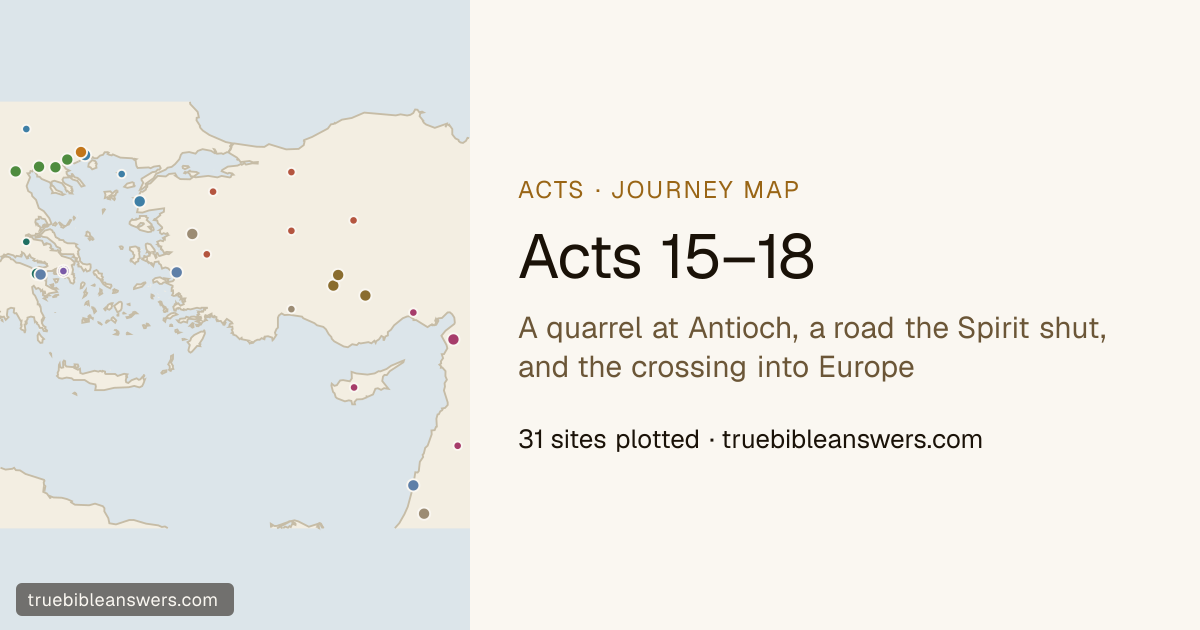
Regions on this map
Acts 15:36–41: one proposal, one sharp disagreement, and two departures. Barnabas takes Mark and sails for Cyprus; Paul takes Silas and walks north through Syria and Cilicia. Only the second road is this journey, and it ends where it began.
Barnabas' road, not Paul's. He takes Mark and sails for his own home island — the first stop of the first journey, walked end to end then — and Luke never mentions either man again. Plotted at the island's centre.
Today: Cyprus (representative point)
Paul's own province, walked through in 15:41 on the way to the Cilician Gates. The council's letter had been addressed to its churches, so strengthening them is the first errand of the journey and the last stretch of familiar ground before the pass.
Today: the Çukurova plain (point at Tarsus) (representative point)
Named at both ends of the journey: walked through in 15:41 on the way out, and named again in 18:18 as the province Paul sets sail for on the way back. The gazetteer's point for it is at Damascus, well south of the road he actually took.
Today: the Roman province of Syria (point at Damascus) (representative point)
The church that sent the journey out and the church it reported back to: Paul leaves from here in 15:40 and comes down to it again in 18:22, and everything on this map happens between those two verses. Not the Antioch of the first journey's sermon, which is three hundred miles north-west in Pisidia.
Today: Antakya, Turkey
Acts 16:1–5: the first journey's Galatian towns reached from the east this time, so Derbe comes first and Iconium last, with the Jerusalem letter delivered into each and Timothy added to the party at Lystra.
The far end of the first journey and therefore the first stop of the second, reached this time from the east through the Cilician Gates instead of from the west. Identified from an inscription found at Kerti Hüyük; two other mounds nearby have also been proposed.
Today: Kerti Hüyük, near Karaman, Turkey
Where Timothy joins, and where Paul had been stoned and left for dead on the last visit. He circumcises Timothy here because of the Jews in those places, days after carrying a letter that said Gentiles need not be.
Today: Zoldera höyük, near Hatunsaray, Turkey
Named at 16:2 as the neighbouring church that spoke well of Timothy rather than as a stop. It stands on the road from Lystra to the Phrygian plateau, the commission at 15:36 was to revisit every city where they had preached, and 16:4 has them delivering the letter through "the cities" — which is as close as the text comes to putting the party inside it.
Today: Konya, Turkey
Acts 16:6–8: forbidden to speak the word in Asia, refused entry to Bithynia, and left walking north-west with the map closing behind them. The two broken lines are roads nobody travelled.
The province they were forbidden to preach in, drawn as a broken line because the road to it was never taken. Paul reaches its capital anyway in 18:19, at the end of the same journey, and stays there for most of the next one.
Today: western Turkey (representative point)
Half of Luke's single phrase at 16:6, the Phrygian and Galatian region, and the ground of a two-century argument about whether he means the old kingdom in the north or the Roman province's southern towns Paul had just left. The map pins the gazetteer's province and draws no road to it, because a line here would settle a question the sentence does not.
Today: the plateau around Ankara (representative point)
The other half of the same phrase, and the country the party is actually crossing when the door to Asia shuts. The walked line runs to its point and no further west, because west is exactly where they were not allowed to go.
Today: west-central Turkey (representative point)
The second refusal, and the sharper one: they did not merely fail to go, they attempted it and the Spirit of Jesus did not allow them. The broken line runs north-east from the Mysian border, which is the direction they were turned back from.
Today: north-west Turkey, around Bolu and İznik (representative point)
The corner of the map where both refusals leave them, named twice in two verses — once as the place they came up to and once as the place they passed by. From here the only road not shut runs downhill to the sea.
Today: north-west Turkey, inland of the Troad (representative point)
Acts 16:9–11: a vision at Troas, a first-person plural that was not in the book before, and two days at sea by way of Samothrace. This is where an Asian circuit becomes a European journey.
The hinge of the whole journey. A Roman colony and the standard crossing point to Macedonia, reached because every other road was closed; here the vision comes, here Luke's narrative turns to "we", and here Asia stops being the story.
Today: Alexandria Troas, near Dalyan, Turkey
The province the vision asks for and the one the journey spends its middle in — named at the call, at the decision, at Philippi, and again at Corinth when Silas and Timothy finally catch up. Plotted at the gazetteer's representative point, north of the road the party actually walked.
Today: northern Greece and North Macedonia (representative point)
The port of Philippi and the first European ground the party stands on, reached on the second day out of Troas with a following wind that a later voyage over the same water would take five days to manage.
Today: Kavala, Greece
A mountain island halfway across, and a night's anchorage rather than a stop: coasting vessels ran from shelter to shelter and this one stands almost exactly on the line from Troas to Neapolis.
Today: Samothraki, Greece (representative point)
Acts 16:12–40: a leading city of its district and a Roman colony, where the first convert in Europe is a purple-seller from Thyatira and the second is the jailer who had been holding them.
Nine miles inland from its port, a Roman colony whose citizens held Roman law — which is why a beating administered to two of them without trial ends with the magistrates apologising in person. The longest single scene on this map.
Today: Philippi, near Krinides, Greece
Acts 17:1–14: the Roman trunk road across Macedonia. Amphipolis and Apollonia are named as places passed through; Thessalonica and Berea are named as places they were run out of.
A day's march west of Philippi on the Egnatian Way, named as somewhere passed through rather than preached in — Luke gives it a participle and no more.
Today: Amfipoli, Greece
The next posting station along the same road, named in the same breath as Amphipolis and for the same reason: it is how far you get in a day, and the party did not stop.
Today: Nea Apollonia, Greece
The provincial capital and the first place on the road with a synagogue Luke bothers to mention. Three Sabbaths of argument, then a mob, then a bond taken from the host — and the trouble follows Paul down the road to Berea afterwards.
Today: Thessaloniki, Greece
Off the trunk road and forty-five miles south-west, reached by night because the alternative was another riot. It is the last place on this journey the party is together: Paul is sent on to the sea alone and Silas and Timothy stay.
Today: Veria, Greece
Acts 17:15–34: Paul sent on alone and waiting for the others, arguing daily in the marketplace until the philosophers take him up the council's hill to say it properly.
Reached alone and, by the plainest reading of 17:14, by sea. Paul waits here for the others and does not wait quietly — the synagogue on the Sabbath and the marketplace every other day, until the philosophers take an interest.
Today: Athens, Greece
The rock below the Acropolis and the council that met on it; the Greek says both and Acts 17 probably means the council. Three hundred metres from where this map plots Athens, which is why no line is drawn between them — the walk of 17:19 is shorter than the width of the pin.
Today: Areios Pagos, below the Acropolis, Athens
Acts 18:1–17: the longest stay on this journey. A trade shared with two exiles from Rome, a synagogue that splits down the middle, and a proconsul of Achaia who refuses to hear the case at all.
A year and six months, against three Sabbaths at Thessalonica and a single speech at Athens. A ruined city rebuilt by Rome a century earlier, with two ports and the traffic of both, and the only place on this journey Paul is told in so many words to stay.
Today: Archaia Korinthos, Greece
The Roman province Corinth was governed as, named for its proconsul: Gallio, whose refusal to hear the charge is the nearest thing to a legal ruling the young movement gets, and whose term in office is what dates this journey. The gazetteer's point for the province falls in central Greece, well north of the city he sat in.
Today: southern Greece (point near Lamia) (representative point)
Acts 18:18–22: east out of Corinth's own port with a vow's haircut behind him, a first stop at the Ephesus he had been kept out of, and a ship to Caesarea for the long road down to Antioch.
Corinth's eastern port, six miles from the city, and the point the homeward voyage actually leaves from. Paul cut his hair here for a vow Luke names and does not explain.
Today: Kechries, Greece
The capital of the province he had been forbidden to speak in at the start of this journey. He reasons in the synagogue, declines to stay, and promises to come back — which is where the third journey goes and where it spends two years.
Today: Efes, near Selçuk, Turkey
The landfall that ends the sea travel, and the port every one of Paul's returns comes through. From here the last stretch is a road, and the journey closes at the church that opened it.
Today: Caesarea Maritima, Israel
Places these chapters name for reasons other than travelling to them: the province Mark quit on an earlier journey, the city whose letter the party carried, a convert's home town, a tentmaker's birth province, and the edict that put Aquila and Priscilla in Corinth.
Not a place this journey goes but the place the quarrel is about: Mark had left the first journey here, and Paul thought best not to take a man who had done that once already.
Today: the Antalya coast (representative point)
Named inside the journey only once, at 16:4, and as an authority rather than a destination: the decisions Paul hands out through Galatia were reached here. He may have gone up to it at 18:22 — "he went up and greeted the church" is the ordinary idiom for it — but the ESV does not name the city there, so the map does not draw the detour.
Today: Jerusalem
The gazetteer reads the Macedonian's appeal at 16:9 as naming Greece; the ESV does not, and calls the man a Macedonian. Kept because the dataset names it, and left as a name only.
the gazetteer resolves it to Athens' own coordinates, which are on this map already
Named for a person, not a port: Lydia, the seller of purple goods whose household is the first baptised in Europe, came from there. It is back in the province the party had just been forbidden to preach in.
Today: Akhisar, Turkey
Where Aquila and Priscilla had just come from when Paul found them, and the reason he found them at all: Claudius had expelled the Jews from Rome, and the expulsion put a tentmaker of his own trade on the bench beside him.
the gazetteer offers Rome's own point for it, and Rome is nine hundred miles west of the frame this journey is drawn to
Aquila's birth province, on the Black Sea coast east of anywhere this journey goes. Luke names it the way he names Thyatira and Alexandria — to say where a person came from, not where the road went.
a birthplace in a passing clause, and the point offered is four hundred miles east of the frame this map is drawn to
Named once, in an edict: Claudius commanded all the Jews to leave it. Paul will not see the city for another ten years and will arrive under guard, but the emperor's decision reaches across this map and staffs his workshop in Corinth.
the decree travelled; nobody in these chapters did. Nine hundred miles west of the frame this map is drawn to, and on /maps/pauls-journey-to-rome under its own pin
Acts 15–18, verse by verse
Acts 15
- Acts 15:38But Paul thought best not to take with them one who had withdrawn from them in and had not gone with them to the work.
- Acts 15:39And there arose a sharp disagreement, so that they separated from each other. Barnabas took Mark with him and sailed away to ,
- Acts 15:41And he went through and , strengthening the churches.
Acts 16
- Acts 16:1Paul came also to and to . A disciple was there, named Timothy, the son of a Jewish woman who was a believer, but his father was a Greek.
- Acts 16:2He was well spoken of by the brothers at and .
- Acts 16:4As they went on their way through the cities, they delivered to them for observance the decisions that had been reached by the apostles and elders who were in .
- Acts 16:6And they went through the region of and , having been forbidden by the Holy Spirit to speak the word in .
- Acts 16:7And when they had come up to , they attempted to go into , but the Spirit of Jesus did not allow them.
- Acts 16:8So, passing by , they went down to .
- Acts 16:9And a vision appeared to Paul in the night: a man of was standing there, urging him and saying, “Come over to and help us.”
- Acts 16:10And when Paul had seen the vision, immediately we sought to go on into , concluding that God had called us to preach the gospel to them.
- Acts 16:11So, setting sail from , we made a direct voyage to , and the following day to ,
- Acts 16:12and from there to , which is a leading city of the district of and a Roman colony. We remained in this city some days.
- Acts 16:14One who heard us was a woman named Lydia, from the city of , a seller of purple goods, who was a worshiper of God. The Lord opened her heart to pay attention to what was said by Paul.
Acts 17
- Acts 17:1Now when they had passed through and , they came to , where there was a synagogue of the Jews.
- Acts 17:10The brothers immediately sent Paul and Silas away by night to , and when they arrived they went into the Jewish synagogue.
- Acts 17:11Now these Jews were more noble than those in ; they received the word with all eagerness, examining the Scriptures daily to see if these things were so.
- Acts 17:13But when the Jews from learned that the word of God was proclaimed by Paul at also, they came there too, agitating and stirring up the crowds.
- Acts 17:14Then the brothers immediately sent Paul off on his way to the sea, but Silas and Timothy remained there.
- Acts 17:15Those who conducted Paul brought him as far as , and after receiving a command for Silas and Timothy to come to him as soon as possible, they departed.
- Acts 17:16Now while Paul was waiting for them at , his spirit was provoked within him as he saw that the city was full of idols.
- Acts 17:19And they took him and brought him to the , saying, “May we know what this new teaching is that you are presenting?
- Acts 17:21Now all the and the foreigners who lived there would spend their time in nothing except telling or hearing something new.
- Acts 17:22So Paul, standing in the midst of the , said: “Men of , I perceive that in every way you are very religious.
- Acts 17:33So Paul went out from their midst.
Acts 18
- Acts 18:1After this Paul left and went to .
- Acts 18:2And he found a Jew named Aquila, a native of , recently come from with his wife Priscilla, because Claudius had commanded all the Jews to leave . And he went to see them,
- Acts 18:5When Silas and Timothy arrived from , Paul was occupied with the word, testifying to the Jews that the Christ was Jesus.
- Acts 18:8Crispus, the ruler of the synagogue, believed in the Lord, together with his entire household. And many of the hearing Paul believed and were baptized.
- Acts 18:11And he stayed a year and six months, teaching the word of God among them.
- Acts 18:12But when Gallio was proconsul of , the Jews made a united attack on Paul and brought him before the tribunal,
- Acts 18:18After this, Paul stayed many days longer and then took leave of the brothers and set sail for , and with him Priscilla and Aquila. At he had cut his hair, for he was under a vow.
- Acts 18:19And they came to , and he left them there, but he himself went into the synagogue and reasoned with the Jews.
- Acts 18:21But on taking leave of them he said, “I will return to you if God wills,” and he set sail from .
- Acts 18:22When he had landed at , he went up and greeted the church, and then went down to .