Paul's first missionary journey: Out through Cyprus, back through every town they had just left
Read it →Paul's first journey is a loop, and the loop is the point: every town on the way out is walked again on the way home. The church at Syrian Antioch fasted, laid hands on Barnabas and Saul and let them go; they walked the sixteen miles down to Seleucia and took ship for Cyprus, which was Barnabas' own island. Salamis at the eastern end, the whole length of it on foot, and at Paphos in the west a Roman proconsul who wanted to hear them and a magician who did not — and from Paphos onward Luke stops writing Saul and writes Paul. They sailed north to Perga on the Pamphylian plain, and there John Mark left them and went back to Jerusalem; Luke gives no reason, and the missing reason is what breaks up the partnership two chapters later. The rest is inland and uphill: a hundred miles over the Taurus onto the plateau, to the second Antioch on this map — the Roman colony in Pisidia, and not the one that sent them. Paul preaches Israel's own history there, the city divides, and they are put out of the district. Iconium goes the same way. At Lystra a lame man walks, the crowd calls them Zeus and Hermes in a language they cannot follow, and the same crowd stones Paul and drags him out of the city for dead; he gets up and walks back in. Derbe is the far end, and the only town on the journey where nothing goes wrong. Then they turn round. Lystra, Iconium, Antioch — every town that had just driven them out, walked again to appoint elders in the churches left behind in them, then down through Pisidia into Pamphylia, a word preached in Perga at last, down to the harbour at Attalia, and one sail east to the Antioch that had sent them. They gathered the church and reported that a door of faith had been opened to the Gentiles, which is the sentence Acts 15 is called to argue about.
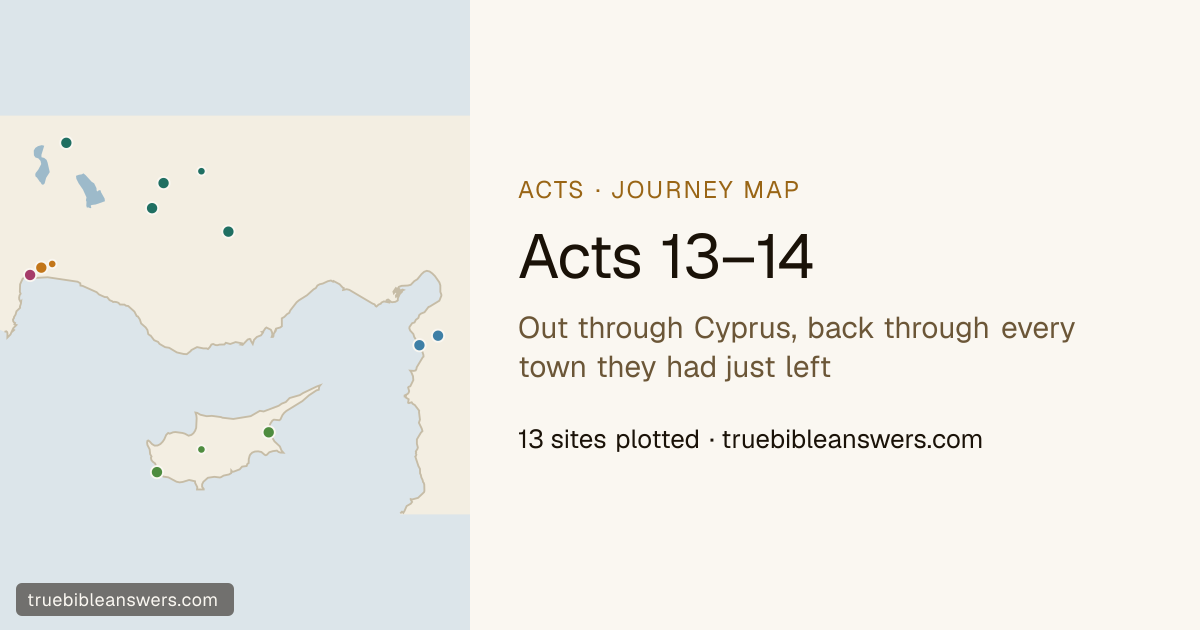
Regions on this map
Acts 13:1–4 and 14:26–28: the church that fasted, laid hands on two of its teachers and let them go is the church they come back to and report to. Seleucia is its harbour, sixteen miles down the Orontes, and Luke names it going out and not coming back.
The third city of the empire and the church that started this: its prophets and teachers fasted, laid hands on Barnabas and Saul and sent them off, and it is the same congregation they gather at the end to tell that a door of faith had been opened to the Gentiles.
Today: Antakya, Turkey
Antioch's harbour, sixteen miles down the Orontes where the river meets the sea, and the only port on the journey Luke names on the way out and leaves unnamed on the way home.
Today: Çevlik, near Samandağ, Turkey
Acts 13:4–13: Barnabas' own island, entered at Salamis in the east and crossed the whole way to Paphos in the west, where a Roman proconsul asks to hear them and the mission first has a hearer of rank.
Barnabas' own island and the mission's first ground — entered at Salamis, gone through whole, left at Paphos. Plotted at the island's centre.
Today: Cyprus (representative point)
The eastern port, the shortest crossing from the Syrian coast, and the first synagogue of the journey — John Mark is still with them here, assisting.
Today: near Famagusta, Cyprus
The Roman capital at the western end, where the proconsul Sergius Paulus sends for them, a magician tries to talk him out of it and goes blind for it, and Luke stops writing Saul and starts writing Paul.
Today: Paphos, Cyprus
Acts 13:13–14: north from Paphos to Perga on the Pamphylian plain, where John Mark turns back for Jerusalem, and then a hundred miles over the Taurus onto a plateau three thousand feet up.
The coastal plain that Perga and Attalia stand in, named coming in and again going out. The party does not settle in it either time: the road out of it goes straight up, over the Taurus and onto the plateau.
Today: the Antalya coast (representative point)
A city seven miles up the Cestrus from the sea, near enough for a ship, which is why 13:13 can say they sailed from Paphos and came to it. They lose John Mark here and pass through without a word preached — the preaching happens on the way home.
Today: Perge, near Aksu, Turkey
Acts 13:14–14:20: Pisidian Antioch, Iconium, Lystra and Derbe, in that order and to the same pattern each time — they preach, some believe, the town divides. Three of the four end in expulsion or stoning; Derbe, the far point, does not.
The second Antioch on this map and not the one that sent them: a Roman colony three and a half thousand feet up, where Paul preaches the long sermon of Acts 13 and is driven out of the district for it. Men from here follow him a hundred miles to Lystra to have him stoned, and he still walks back through it on the way home.
Today: Yalvaç, Turkey
The highland district Antioch stood on the edge of, named twice — once to say which Antioch, and once for the country they came back down through on the way to the coast.
the gazetteer resolves it to Antioch in Pisidia's own point, and one place does not want two markers
Roughly eighty miles south-east of Pisidian Antioch on the Via Sebaste, and the longest stay of the outward leg — they remain a long time, until word of a plan to stone them moves them on.
Today: Konya, Turkey
The far point of the journey and the only town on it where nothing goes wrong. Its site was guesswork until 1956, when a stone naming the Derbeans turned up at Kerti Höyük; older atlases had put it some thirty miles further west.
Today: Kerti Höyük, near Karaman, Turkey
The district Lystra and Derbe belong to, and the reason the crowd at Lystra could call Barnabas Zeus and Paul Hermes without either of them understanding in time to stop it — the shout was in Lycaonian. Plotted at the district's approximate centre.
Today: the plain around Konya and Karaman (representative point)
A Roman colony off the main road, fixed to the mound near Hatunsaray by an inscribed altar found there in 1885. A lame man walks, a crowd tries to sacrifice to them, and the same crowd stones Paul and drags him out of the city for dead; he gets up and goes back in.
Today: the mound at Hatunsaray, Turkey
Acts 14:21–28: from Derbe they turn round and walk back through every town that had just driven them out, appointing elders as they go, and come down to the sea at Attalia for one sail home.
The harbour the journey goes home from, founded by Attalus II of Pergamum and still the region's port. It is named only on the return: they came in by the river to Perga and left from the open coast.
Today: Antalya, Turkey
Places the span names for reasons other than going to them: one teacher's home city, the city one companion goes back to, and the three lands Paul's sermon at Pisidian Antioch walks the congregation through. None is on the itinerary and none carries a pin.
Named for a man rather than a place: Lucius of Cyrene is one of the five prophets and teachers at Antioch who send the mission out, and nobody on this journey goes near Libya.
in the list of who sent them, not on the route; its point is nine hundred miles outside the frame this map is drawn to
Named three times in this span and reached none of them: it is where John Mark goes when he leaves the party at Perga, and where the sermon at Pisidian Antioch puts both the condemnation and the witnesses who saw the resurrection.
the destination of the man who left, and a location inside a sermon; four hundred miles south of the frame this map is drawn to
In the sermon, not on the itinerary: Paul starts Israel's story with the stay in Egypt and the uplifted arm that led them out of it.
a land inside a sermon, and the point offered is Heliopolis — one city standing in for four hundred years in a whole country, six hundred miles off this frame
The next step of the same sermon — seven nations destroyed and the land handed over as an inheritance — and a name that had not described anywhere for a thousand years by the time Paul used it in a synagogue in Asia Minor.
a land inside a sermon, and the point offered is a centroid for the whole of it; off the frame besides
Where the witnesses came from, in the sermon's last movement: those who came up with Jesus from Galilee to Jerusalem are the people now saying he was raised.
a district inside a sermon, four hundred miles south of the frame this map is drawn to
Acts 13–14, verse by verse
Acts 13
- Acts 13:1Now there were in the church at prophets and teachers, Barnabas, Simeon who was called Niger, Lucius of , Manaen a lifelong friend of Herod the tetrarch, and Saul.
- Acts 13:4So, being sent out by the Holy Spirit, they went down to , and from there they sailed to .
- Acts 13:5When they arrived at , they proclaimed the word of God in the synagogues of the Jews. And they had John to assist them.
- Acts 13:6When they had gone through the whole island as far as , they came upon a certain magician, a Jewish false prophet named Bar-Jesus.
- Acts 13:13Now Paul and his companions set sail from and came to in . And John left them and returned to ,
- Acts 13:14but they went on from and came to in . And on the Sabbath day they went into the synagogue and sat down.
- Acts 13:17The God of this people Israel chose our fathers and made the people great during their stay in the land of , and with uplifted arm he led them out of it.
- Acts 13:19And after destroying seven nations in the land of , he gave them their land as an inheritance.
- Acts 13:27For those who live in and their rulers, because they did not recognize him nor understand the utterances of the prophets, which are read every Sabbath, fulfilled them by condemning him.
- Acts 13:31and for many days he appeared to those who had come up with him from to , who are now his witnesses to the people.
- Acts 13:51But they shook off the dust from their feet against them and went to .
Acts 14
- Acts 14:1Now at they entered together into the Jewish synagogue and spoke in such a way that a great number of both Jews and Greeks believed.
- Acts 14:6they learned of it and fled to and , cities of , and to the surrounding country,
- Acts 14:8Now at there was a man sitting who could not use his feet. He was crippled from birth and had never walked.
- Acts 14:11And when the crowds saw what Paul had done, they lifted up their voices, saying in , “The gods have come down to us in the likeness of men!”
- Acts 14:19But Jews came from and , and having persuaded the crowds, they stoned Paul and dragged him out of the city, supposing that he was dead.
- Acts 14:20But when the disciples gathered about him, he rose up and entered the city, and on the next day he went on with Barnabas to .
- Acts 14:21When they had preached the gospel to that city and had made many disciples, they returned to and to and to ,
- Acts 14:24Then they passed through and came to .
- Acts 14:25And when they had spoken the word in , they went down to ,
- Acts 14:26and from there they sailed to , where they had been commended to the grace of God for the work that they had fulfilled.
- Acts 14:27And when they arrived and gathered the church together, they declared all that God had done with them, and how he had opened a door of faith to the Gentiles.